Causes & symptoms
Water Retention Symptoms: How to Tell If It's More Than Bloating

By Dana Reyes
Published Sep 8, 2026 · 10 min read
Quick answer
Water retention feels like puffiness that leaves a dent when you press it, skin that's tight or shiny, and weight that jumps overnight rather than creeping up over weeks. Most of it is ordinary — salt, hormones, sitting too long. It's worth a doctor's attention when it's in one leg only, comes with shortness of breath, or you gain more than 2 pounds in a day.
Editorial note: This article links to a supplement we independently reviewed. If you buy through it we may earn a small commission at no cost to you. This page is educational — not medical advice.
What does water retention actually feel like?
Before any of it looks like swelling, it usually feels like tightness. A ring that won't come off as easily, socks leaving a deeper mark than usual, a waistband that fit fine yesterday. Cleveland Clinic describes the pattern plainly: affected areas look puffy, enlarged or swollen, the skin over them can look shiny or stretched or feel tight, and using that part of the body can feel harder simply because it's bigger than usual.
None of that requires a diagnosis to notice. It's the next question — whether it's ordinary or something to watch — that most articles on this topic answer poorly.
Cleveland Clinic lists edema symptoms including "Part(s) of your body look puffy, enlarged or swollen," "Skin that looks shiny, stretched or feels tight," and "Difficulty using affected body parts because they're bigger or don't move as well."
Cleveland Clinic — Edema.
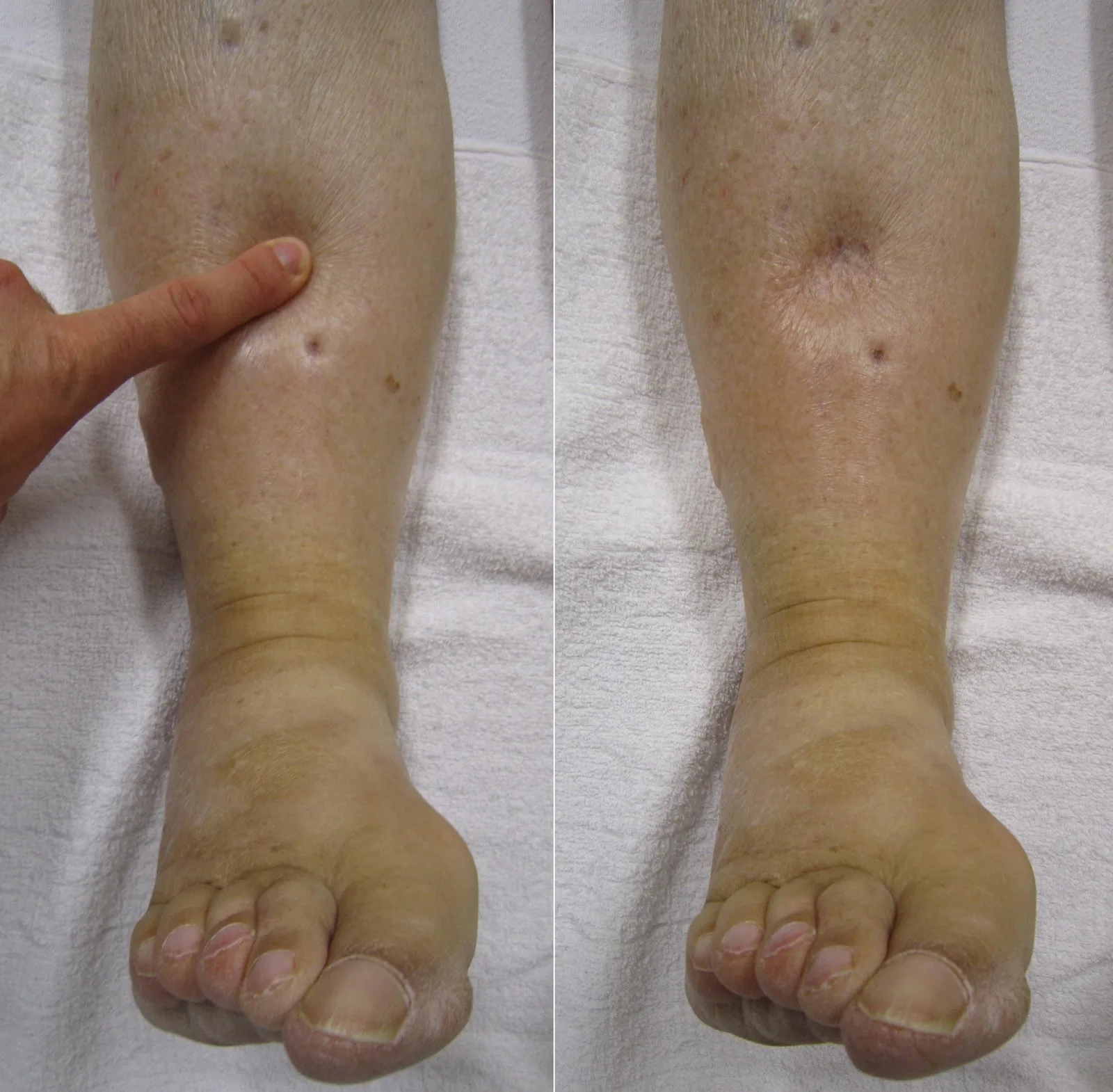 Pitting edema: the skin holds the shape of a finger press for several seconds to a few minutes, depending on severity. Photo: James Heilman, MD (CC BY-SA 3.0, Wikimedia Commons).
The pitting test — how to check it yourself
This is the test doctors actually use, and you can do a rough version of it at home. Press a finger firmly into swollen skin — the shin or the top of the foot works best — hold for a few seconds, then let go and watch.
If a dent stays behind, that's fluid trapped under the skin, and how fast it disappears is roughly how it gets graded: a mild case rebounds almost immediately, a moderate one takes up to 15 seconds, and more significant fluid buildup can take a minute or longer to smooth back out.
Medical News Today: "Pitting edema is when an indentation remains after pressing swollen skin." Grading by rebound time ranges from swelling that "rebounds immediately" to swelling that "takes 2–3 minutes to rebound."
Medical News Today — Pitting edema.
Not every swollen ankle pits — some fluid, and some causes of swelling that aren't fluid at all, won't leave a mark. But when it does pit, it's a reliable, free way to confirm what you're feeling is genuinely fluid, not just tiredness or imagination.
Weight is the earlier warning sign — before you'd call yourself swollen
The part almost no one mentions: by the time you can see swelling in your legs or belly, your body has usually already been holding onto extra fluid for a while. Harvard Health puts a number on it — most people carry 8 to 15 extra pounds of fluid before it becomes visible as leg or belly swelling.
That makes the bathroom scale a better early-warning tool than the mirror. A sudden jump is the signal worth tracking, not the slow creep that's more likely to be ordinary weight change.
Harvard Health: "Weight change is the earliest sign of a problem with fluid balance," and "most people will retain 8 to 15 pounds of excess fluid before they see leg and belly swelling." As a guide for when to act: "If you gain more than 2 pounds in a day or 4 pounds in a week," it's worth calling your doctor.
Harvard Health — Fluid retention: what it can mean for your heart.
That threshold — 2 pounds in a day, 4 in a week — is a genuinely useful number to keep in mind, especially if you have any history of heart, kidney or liver issues. It's specific enough to act on, unlike "watch for swelling," which by definition comes later.
Why symptoms change by time of day
If your ankles are fine at breakfast and tight by dinner, that's not your imagination — it's gravity. Standing or sitting upright for hours lets fluid drift downward and settle in your feet and ankles, which is why swelling there is almost always worse by evening.
Lie down for the night and that pull disappears. Part of the same fluid then redistributes upward, which is one reason some people wake up with a puffier face than they went to bed with. It's the same total fluid load moving around your body on a schedule set by posture, not two unrelated symptoms.
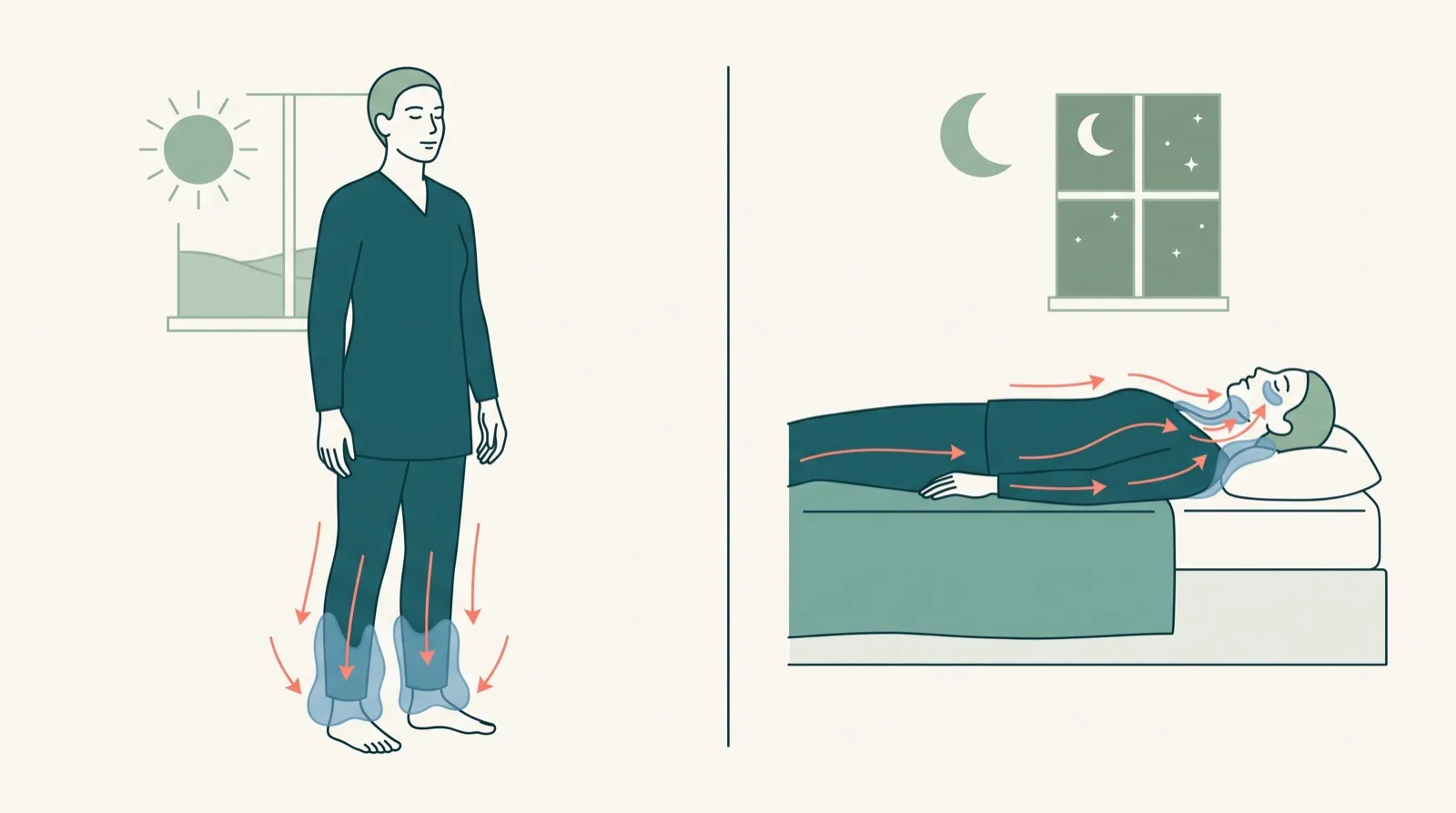 Upright, gravity pulls fluid into the ankles. Flat, that pull disappears and part of the same fluid travels back up.
This is why the same underlying fluid retention can show up as three different-looking symptoms depending on the hour: tight ankles by evening, a puffier face by morning, and a fuller belly whenever the total load runs high. Our pillar guide to swollen ankles and morning facial puffiness cover the other two ends of the same pattern, and the full list of causes covers what raises that total load in the first place.
When it's more than everyday bloating
Ordinary water retention has a shape to it: both legs, gradual onset, and it eases with time, less salt, or your feet up for twenty minutes. The symptoms below don't fit that shape, and that's exactly what makes them worth paying attention to.
Swelling in one leg only
Salt, hormones and sitting are whole-body causes — they don't pick a side. Swelling confined to a single leg, especially if it's new, painful, warm to the touch, or reddened, points somewhere else, and the most serious possibility is a blood clot.
NHS: get help if "you have swelling in 1 ankle, foot or leg and you don't know what's causing it." Cleveland Clinic lists "Swelling that affects only one limb (especially a leg)" among the reasons to see a doctor about edema.
NHS — Oedema ·
Cleveland Clinic — Edema.
Breathing or chest symptoms alongside swelling
Fluid retention that's connected to the heart, lungs or a blood clot rarely stays quiet — it tends to bring breathing symptoms along with it. This combination is not something to sit with and monitor; it's a reason to get seen the same day.
Medical News Today: "Anyone experiencing shortness of breath, difficulty breathing, chest pain, or swelling in a single limb should seek immediate medical attention." The NHS lists the same emergency pattern: "you feel short of breath or are struggling to breathe," "your chest feels tight, heavy or painful," "you're coughing up blood."
Medical News Today — Pitting edema ·
NHS — Oedema.
Rapid weight gain plus feeling full or breathless
This is the pattern most associated with heart failure specifically. Harvard Health describes fluid buildup that can escalate quickly, with coughing, shortness of breath, loose stools, nausea or feeling full without eating much showing up as the fluid load climbs. Anyone with an existing heart condition should treat this combination as urgent, not something to wait out over a weekend.
Track these, not just the swelling
- Your weight, daily if you can. A jump of 2+ pounds in a day or 4+ in a week is the earliest reliable signal — well before you'd see swelling.
- Which side. Both legs together points to ordinary fluid retention. One leg alone points elsewhere and needs a doctor.
- The pitting test. A press-and-release dent that lingers confirms it's fluid, not just tiredness.
- Any breathing symptom at the same time. Shortness of breath, a tight chest, or a new cough alongside swelling is never a "wait and see."
- How it changes across the day. Worse by evening in the legs, worse by morning in the face — that pattern itself is normal, not a red flag on its own.
See a doctor if:
- Swelling affects only one leg or ankle, especially if it's new, painful, warm or red.
- You gain more than 2 pounds in a day or 4 pounds in a week without another explanation.
- Swelling doesn't improve after a few days, or keeps coming back.
- You have a history of heart, kidney or liver disease and notice any new swelling.
Get medical help right away if swelling comes with shortness of breath, a tight or painful chest, or coughing up blood. These match the emergency pattern that Medical News Today and the NHS both flag — not a diagnosis, just the signal that this isn't the kind of swelling a home remedy is meant for.
Reader-favorite formula
Flush Factor Plus — the fluid-balance supplement we reviewed
Flush Factor Plus is a plant-based formula built on six plant-derived ingredients — pineapple (bromelain), shatavari, L-citrulline, black cumin seed, beet root and hibiscus — in a single 500 mg blend. It's aimed at the everyday symptoms above: puffiness, tight rings, ankles that swell by evening. It is not aimed at one-sided swelling, breathing symptoms, or any of the red flags in this article — no supplement replaces a diagnosis or treats heart, kidney or liver disease. Our full review covers which claims hold up, who should skip it, and the side effects worth knowing.
Price, shipping and guarantee. The official site sells bundles only, no single bottles: $158 USD for 2 bottles ($79 each), $207 for 3 ($69 each) or $294 for 6 ($49 each). Shipping is free inside the United States, 5–7 working days ($15.95 USD to Canada, the UK and Ireland, and Australia and New Zealand, 10–15 working days). Every official order carries a 60-day money-back guarantee that starts the day your package is delivered — it covers opened bottles, but you post them back at your own cost. Prices verified on the official checkout on August 25, 2026.
Read the full Flush Factor Plus review →
Affiliate link. Independent review. Not a substitute for a doctor.
Frequently asked questions
What are the symptoms of water retention?
The main signs are puffiness or swelling in the feet, ankles, hands, face or belly, skin that looks shiny or stretched or feels tight, a heavy or achy feeling in the affected area, and weight that jumps by a pound or more overnight. Rings, shoes or waistbands feeling tighter than usual is often the first thing people notice, before they'd describe themselves as swollen.
How do you test for water retention at home?
Press a finger firmly into the swollen skin, over your shin or the top of your foot, for a few seconds, then let go. If a dent stays behind, that's pitting edema — fluid trapped under the skin. How long the dent takes to bounce back is roughly how doctors grade severity, from rebounding immediately to taking two to three minutes. Not all water retention pits, but when it does, it's a clear sign.
How much weight gain counts as water retention?
Harvard Health notes that weight change is the earliest sign of a fluid problem, often showing up before you'd notice any visible swelling — most people retain 8 to 15 pounds of extra fluid before their legs or belly actually look swollen. As a guide for when to call a doctor, gaining more than 2 pounds in a day or 4 pounds in a week is the threshold worth acting on, especially with a history of heart, kidney or liver disease.
Is water retention worse in the morning or at night?
Both, in different places. Standing or sitting upright all day lets gravity pull fluid down into your ankles and feet, so they're at their worst by evening. Lying flat all night removes that pull, and part of the same fluid shifts back up toward your face, which is why puffiness there is worst first thing in the morning. It's the same fluid moving, not two separate problems.
When is swelling a sign of a heart, kidney or liver problem?
Ordinary water retention is usually in both legs, comes on gradually, and eases with time, salt, or elevation. Swelling tied to the heart, kidneys or liver tends to be more persistent, often affects both legs and the belly together, and comes with other signs — shortness of breath, coughing, feeling full after small meals, or rapid weight gain. Any of those alongside swelling is a reason to call a doctor rather than wait it out.
Why is swelling in one leg different from swelling in both?
Water retention from salt, hormones or sitting almost always affects both legs at once, because it's a whole-body fluid issue. Swelling in only one leg — especially if it's new, painful, warm, or red — points somewhere else, most seriously a blood clot. Both the NHS and Cleveland Clinic list one-sided limb swelling as a reason to get medical care specifically because it doesn't fit the pattern of ordinary fluid retention.
When should I see a doctor about water retention?
See a doctor if swelling is in one limb only, doesn't improve after a few days, or keeps coming back. Get medical help right away if swelling comes with shortness of breath, chest pain or tightness, or coughing up blood — these can signal a blood clot or heart problem and shouldn't wait for a routine appointment.
About the author — Dana Reyes
Founder, The Light Legs Guide
For years Dana worked ten-hour shifts on her feet in retail, so she knows exactly how heavy and sore legs feel at the end of a hot day — and how much a long flight makes it worse. Swelling runs in her family too: her mother, grandmother, aunts and cousins all deal with it. She started The Light Legs Guide to share what actually helped her, with every claim linked to a source you can check.
Dana is not a medical professional. Nothing on this site is medical advice.