Causes & symptoms
Puffy Face in the Morning: Water Retention on the Face Explained

By Dana Reyes
Published Sep 4, 2026 · 11 min read
Quick answer
Your face puffs up overnight because lying flat changes where gravity sends your fluid. What pools in your ankles all day drains back toward your head while you sleep, and the loosest tissue you have — the skin around your eyes — shows it first. Everyday morning puffiness settles within an hour or two of being upright. Swelling that doesn't is worth checking.
Editorial note: This article links to a supplement we independently reviewed. If you buy through it we may earn a small commission at no cost to you. This page is educational — not medical advice.
Why is your face puffy when you wake up?
Nothing went wrong overnight. Your fluid simply moved.
Tiny blood vessels called capillaries constantly let a little fluid seep into the surrounding tissue, and your lymphatic system drains it back out. Swelling — the medical term is edema — happens when more fluid leaks in than drains away. Where that fluid ends up depends almost entirely on which way is down.
Spend the day upright and down means your feet. Lie flat for seven or eight hours and there is no longer a downhill for your legs, so some of the fluid they were holding travels back toward your head. It settles where the tissue is loosest and the skin thinnest, which is exactly the area around your eyes.
 Morning puffiness is most visible around the eyes, where the skin is thinnest and the tissue underneath holds fluid most easily.
Mayo Clinic: edema "occurs when tiny blood vessels in the body, also known as capillaries, leak fluid," and "the fluid builds up in nearby tissues."
Mayo Clinic — Edema. NIH StatPearls on position: "Dependent edema is commonly associated with venous insufficiency, often improving with elevation and worsening with prolonged standing or sitting."
NCBI Bookshelf — Peripheral Edema.
Your puffy face and your swollen ankles are the same problem
This is the part nearly every article on morning puffiness leaves out, and it changes what you do about it.
If your ankles are thick by evening and your face is thick by morning, those are not two separate complaints. They are one pool of fluid, taking turns. The fluid that leaves your legs at night does not evaporate — it goes somewhere, and part of it goes up.
Sleep researchers have actually measured this, because the same upward shift narrows the airway and worsens snoring. In a 2009 study, researchers tracked 23 men through a night and measured how much fluid left their legs and how much their necks thickened. The two moved together almost in lockstep: the more fluid the legs lost overnight, the more the neck grew. The amount of time the men had spent sitting the day before predicted how much fluid was there to move in the first place.
Be clear about what that study did and didn't show. It measured necks, not faces, in a small group of men referred for sleep testing, and its subject was sleep apnea. What it demonstrates is the mechanism — fluid genuinely relocates upward when you lie down, in measurable amounts, and daytime sitting is what loads the legs.
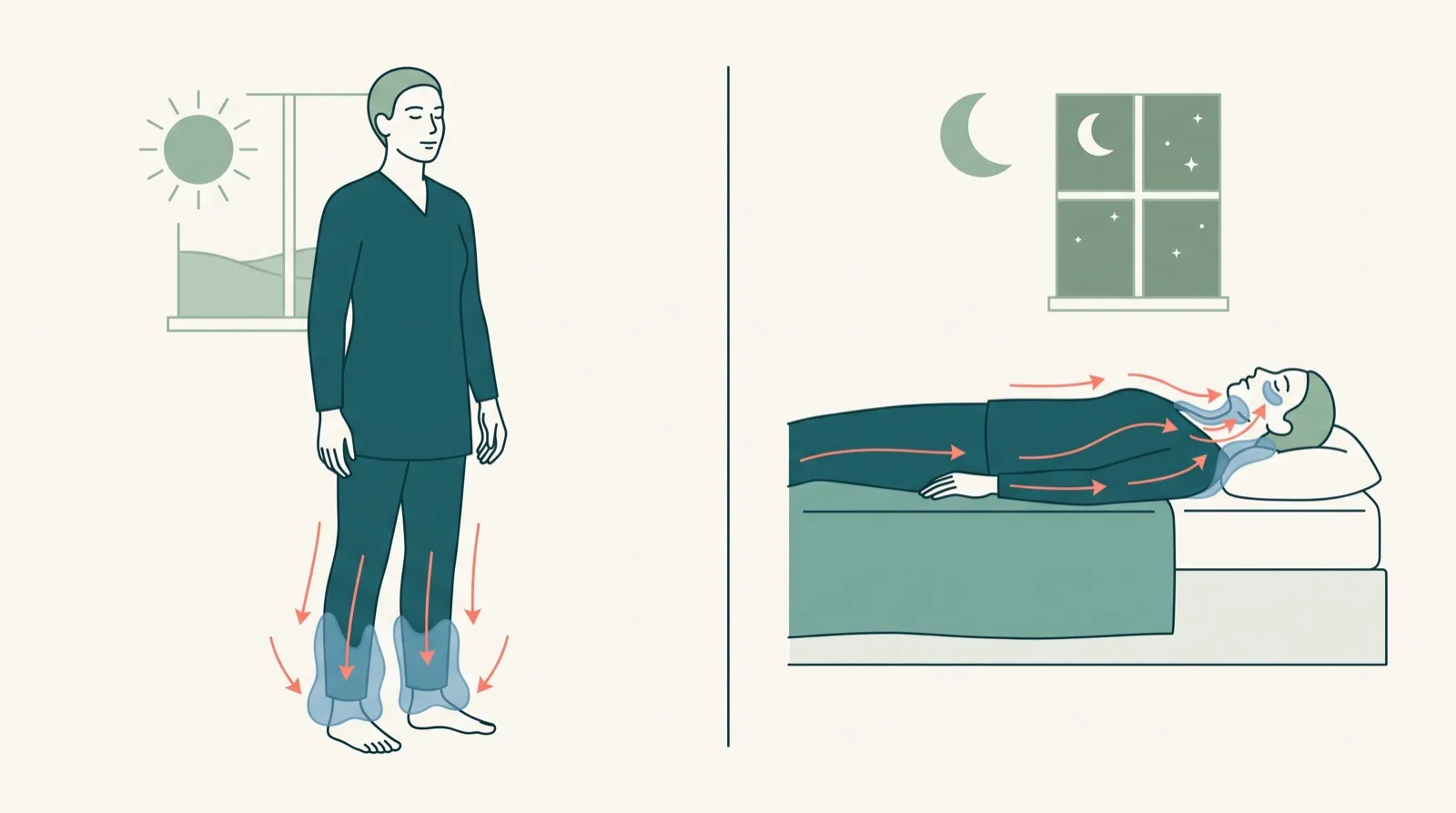 The day-and-night switch: upright, gravity pulls fluid into the ankles. Flat, that pull disappears and part of the same fluid travels back toward the head.
Redolfi S, et al. "Relationship between overnight rostral fluid shift and Obstructive Sleep Apnea in nonobese men."
Am J Respir Crit Care Med 2009;179(3):241–6, PMID 19011149. The paper states that "prolonged sitting leads to dependent fluid accumulation in the legs," and reports that "the overnight change in leg fluid volume correlated strongly with the AHI (r = -0.773, P < 0.001), the change in neck circumference (r = -0.792, P < 0.001), and the time spent sitting (r = -0.588, P = 0.003)."
PubMed.
The practical consequence is worth sitting with. If you want a less puffy face at 7 a.m., some of the work happens at 3 p.m. — getting up from the chair, walking, keeping the calf pump running so less fluid accumulates in your legs to begin with. Our pillar guide to swollen ankles covers that half of the problem in detail, and the article on water retention in the legs explains how to tell everyday pooling apart from a vein problem.
The everyday causes you can actually change
Most morning puffiness traces back to one of these four. None needs a diagnosis.
1. What you ate the night before
Wherever sodium goes, water follows. A salty dinner leaves your kidneys working through the excess for hours, and the extra water it holds is in your body while you sleep — which is precisely when the fluid is heading upward. This is why a restaurant meal or takeaway shows on your face the next morning more reliably than on the scale.
Most of that sodium is not from the salt shaker, which is why "I don't add salt" is rarely the answer.
American Heart Association: "Americans consume far too much sodium — on average, over 3,100 milligrams daily," against "an optimal goal of no more than 1,500 mg a day for most adults." The same page notes that "more than 70% of the sodium Americans eat comes from packaged, prepared and restaurant foods — not the saltshaker."
AHA — How much sodium should I eat per day? (last reviewed July 2025).
2. Sleeping flat, and sleeping badly
The flatter you sleep, the more freely fluid travels toward your head, and a face-down or side-sleeping position lets it settle against the cheek and eyelid pressed into the pillow. Raising the head of the bed, or adding a second pillow, tilts the odds back the other way.
Short nights matter separately. Cleveland Clinic lists inadequate sleep among the things that make facial swelling worse, alongside salt and dehydration.
3. Not drinking enough — and drinking alcohol
Cutting back on water when you feel puffy is the most common mistake here, and it backfires. When your body senses it is short of fluid, it holds on to what it has instead of releasing it. Steady sipping through the day works better than a large glass at bedtime, which mostly wakes you up.
Alcohol works against you on the same axis: it sends more fluid out through your kidneys during the evening, leaving your body in exactly the state where it wants to cling to sodium and water overnight.
Cleveland Clinic's advice for reducing facial swelling: "Reduce your salt intake: Too much salt (sodium) can cause your body to retain fluid, which increases swelling"; "Drink more water: When you're dehydrated, your body holds onto more fluid, leading to swelling"; "Get enough sleep: If you don't get an adequate amount of rest, it can lead to facial swelling and inflammation."
Cleveland Clinic — Moon Face.
4. Sitting all day
It sounds unrelated to your face, and it is the most direct lever you have. Every hour you spend seated is an hour your calf muscles are not pumping fluid back up out of your legs. That fluid is still in you at bedtime — and, as the sleep study above measured, the longer the previous day's sitting, the more of it moves upward overnight.
What does cortisol face look like?
"Cortisol face" is a term that spread on social media faster than anyone could define it, and it now sends a lot of people looking at their own reflection at 7 a.m. wondering whether a stressful month is showing on their cheekbones.
The medical version is real, but it is not what most people are seeing in the mirror.
Moon face — moon facies — is a specific, gradual change in the shape of the face: swelling and fat deposits along the sides, enough to round the face out permanently. Cleveland Clinic ties it mainly to long-term corticosteroid medicines such as prednisone, and to Cushing's syndrome and hypothyroidism. It is not the outcome of a hard week at work.
The clearest way to tell them apart is the clock. Morning water retention comes and goes: worst at wake-up, better by mid-morning, back tomorrow. Moon face builds over weeks and does not improve as the day goes on. If yours belongs in the second category — and especially if you have been on a steroid medicine for more than a few weeks — that is a conversation with the prescriber, not a skincare problem. Never stop a steroid on your own; Cleveland Clinic is explicit that the dose has to be reduced gradually.
Cleveland Clinic: "Moon face (moon facies) is swelling that builds up on the sides of your face, making it look puffy and round, like a full moon," and "the buildup of fat deposits in the side of your skull can make your face so round that you can't see your ears from the front." Causes listed are long-term corticosteroid use, Cushing's syndrome and hypothyroidism.
Cleveland Clinic — Moon Face.
When a puffy face is a thyroid, kidney or pregnancy sign
These are less common than a salty dinner. They are also the reason this article does not end with a cold spoon.
Your thyroid
Mayo Clinic lists "puffy face" outright among the symptoms of an underactive thyroid, in the same list as tiredness, sensitivity to cold, dry skin, weight gain and a hoarse voice. The swelling of hypothyroidism has a name of its own — myxedema — and it behaves differently from ordinary fluid: it favours the eyelids, face and hands, and it is usually non-pitting, meaning a firm finger press does not leave a dent that lingers.
If your morning face never quite deflates and it arrives with fatigue and cold hands, a blood test answers the question in a week.
Mayo Clinic lists "Puffy face." among hypothyroidism symptoms.
Mayo Clinic — Hypothyroidism. NIH StatPearls: "Myxedema, associated with hypothyroidism, typically causes edema in the eyelids, face, and hands," and presents "commonly associated with nonpitting periorbital edema."
NCBI Bookshelf — Peripheral Edema.
Your kidneys
Of all the organs, the kidneys are the one that most often announces itself on the face. Mayo Clinic is specific about the pattern: swelling from kidney disease usually shows up in the legs and around the eyes — the same two-ended pattern this whole article is about, but driven by disease rather than by gravity.
The detail that separates the two is what else is happening. Puffy eyelids on their own after a salty dinner are ordinary. Puffy eyelids together with foamy urine, unexplained weight gain from fluid, or swelling that never settles are a reason to book an appointment.
Mayo Clinic: "Kidney disease can cause fluid and salts in the blood to build up. Edema linked to kidney disease usually occurs in the legs and around the eyes."
Mayo Clinic — Edema. NIDDK lists "puffy eyelids and swelling in the legs, ankles, feet, lower abdomen, or other parts of your body" and "foamy urine" among the symptoms of nephrotic syndrome.
NIDDK — Nephrotic Syndrome in Adults.
Pregnancy
Mild swelling in pregnancy is expected. Sudden facial swelling is not, and it is on the NHS list of pre-eclampsia symptoms alongside a severe headache, vision problems and pain below the ribs. Pre-eclampsia is most likely from 20 weeks onwards but can appear at any point, and sometimes in the days or weeks after birth. This one does not wait for the next routine appointment.
NHS lists "sudden swelling of the face, hands or feet" among the symptoms of pre-eclampsia, adding that "any of these symptoms can be serious and need to be checked immediately."
NHS — Pre-eclampsia.
How to depuff a morning face
Everything below moves fluid faster or gives it less reason to gather. None of it treats a medical cause, which is why the doctor list follows it rather than the other way round.
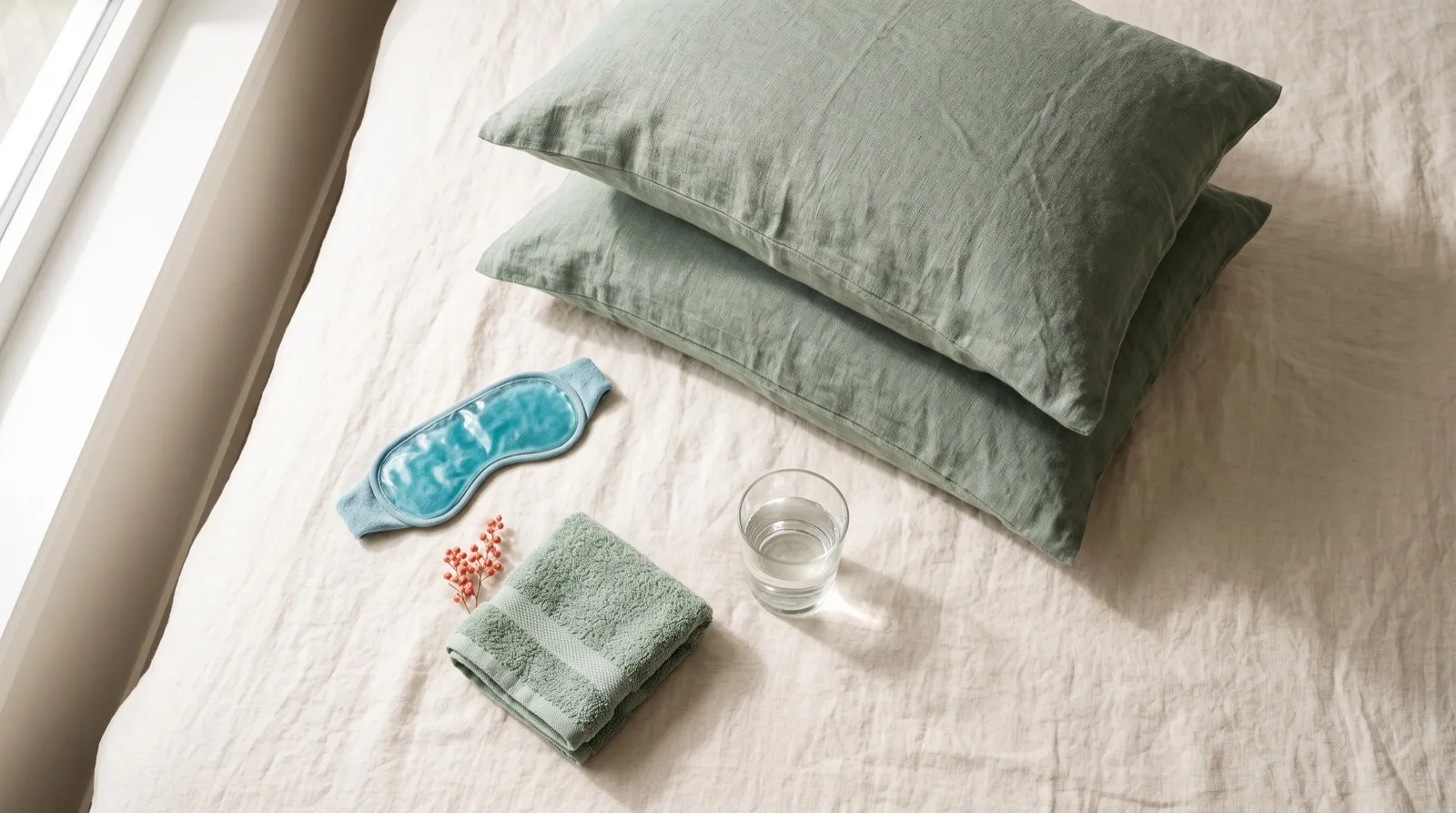 The whole toolkit: a cold compress, water through the day, and an extra pillow so tonight goes better than last night.
What actually helps, in order of effect
- Get upright and move. Gravity and your calf muscles do more in ten minutes of walking than anything you put on your skin.
- Raise your head at night. An extra pillow, or raising the head of the bed, reduces how far fluid travels upward while you sleep.
- Cold on closed eyes for a few minutes. A chilled compress or a cool damp cloth. Cold narrows blood vessels, which is why it works fast and briefly.
- Deal with dinner, not breakfast. The salt that puffs your face at 7 a.m. was eaten at 8 p.m. Sauces, deli meat, bread, restaurant meals and takeaway are where it hides.
- Drink steadily through the day. Cutting fluid makes your body hold on to more. Spread it out rather than loading up at bedtime.
- Break up the sitting. Less fluid parked in your legs at bedtime means less available to move up to your face.
- Check your medicines. If puffiness started within weeks of a new prescription, that timing is worth mentioning to whoever prescribed it — but don't stop anything on your own.
See a doctor if:
- Your face, eyelids or lips swell suddenly, especially with a rash or itching — this can be an allergic reaction.
- Swelling affects one side of your face only, or comes with pain, heat or fever.
- You are pregnant or recently gave birth and your face, hands or feet swell suddenly — contact your maternity unit or call 111 (UK) / your provider straight away.
- Puffiness never fully settles during the day, or arrives with fatigue, cold intolerance, hoarseness or weight gain.
- You notice foamy urine, or sudden weight gain from fluid.
- Your face has been rounding gradually over weeks while taking a steroid medicine.
Emergency: the NHS advises calling 999 if your lips, mouth, throat or tongue suddenly become swollen, if you are struggling to breathe or swallow, or if your skin, tongue or lips turn blue, grey or pale. These can be signs of a serious allergic reaction (anaphylaxis), which needs immediate hospital treatment.
Reader-favorite formula
Flush Factor Plus — the fluid-balance supplement we reviewed
Flush Factor Plus is a plant-based formula built on six plant-derived ingredients — pineapple (bromelain), shatavari, L-citrulline, black cumin seed, beet root and hibiscus — in a single 500 mg blend. It is aimed at the everyday fluid balance described in the first half of this article, not at the thyroid, kidney or pregnancy causes in the second half — no supplement replaces a blood test or a diagnosis. Our full review covers which claims hold up, who should skip it, and the side effects worth knowing.
Price, shipping and guarantee. The official site sells bundles only, no single bottles: $158 USD for 2 bottles ($79 each), $207 for 3 ($69 each) or $294 for 6 ($49 each). Shipping is free inside the United States, 5–7 working days ($15.95 USD to Canada, the UK and Ireland, and Australia and New Zealand, 10–15 working days). Every official order carries a 60-day money-back guarantee that starts the day your package is delivered — it covers opened bottles, but you post them back at your own cost. Prices verified on the official checkout on August 25, 2026.
Read the full Flush Factor Plus review →
Affiliate link. Independent review. Not a substitute for a doctor.
Frequently asked questions
Why is my face very puffy when I wake up?
Because lying flat for seven or eight hours changes where gravity sends your fluid. Standing and sitting all day pulls fluid down into your feet and ankles. Lying down removes that downhill pull, and some of that fluid moves back up toward your head and settles in the loosest tissue you have, which is the skin around your eyes. A salty dinner, alcohol, a short night or a face-down sleeping position all make it more noticeable. Everyday morning puffiness usually eases within an hour or two of being upright and moving.
How do I depuff my face in the morning?
Get upright and move first, because gravity and your calf muscles do more than anything you can apply to your skin. Then use a cold compress on closed eyes for a few minutes, drink water steadily rather than all at once, and sleep with your head slightly raised so tonight is better than last night. Cleveland Clinic's own advice for reducing facial swelling is to cut salt, drink enough water and get enough sleep. These steps move fluid faster. They do not treat a medical cause, so swelling that never fully settles still needs a doctor.
What does cortisol face look like?
Cleveland Clinic describes moon face — the medical term is moon facies, and some people call it cortisol face — as swelling that builds up on the sides of your face, making it look round and puffy like a full moon, sometimes to the point where you cannot see the ears from the front. The important difference from ordinary morning puffiness is timing: moon face builds gradually over weeks and stays all day, while morning water retention comes and goes with the clock. Cleveland Clinic links it mainly to long-term corticosteroid medicines like prednisone, and to Cushing's syndrome and hypothyroidism — not to a stressful week.
Why is my face puffier as I get older?
Partly because the drainage system that clears fluid works less well with age. NIH StatPearls states that the most common cause of peripheral edema in people aged 50 or older is venous insufficiency, typically associated with aging, and puts the prevalence of chronic peripheral edema in older US adults at 19% to 20%. The same source lists female sex and advanced age among the factors that raise the risk. More fluid sitting in the tissue during the day means more fluid available to move upward at night.
Can a puffy face be a thyroid problem?
Yes. Mayo Clinic lists "puffy face" outright among the symptoms of hypothyroidism, alongside tiredness, sensitivity to cold, dry skin, weight gain and a hoarse voice. NIH StatPearls adds that myxedema, the soft tissue swelling of hypothyroidism, typically causes edema in the eyelids, face and hands, and is usually non-pitting — meaning a finger press does not leave a dent. A blood test settles the question, and thyroid swelling does not clear with cold compresses.
Can kidney problems cause a puffy face?
Yes, and the face is one of the places it shows first. Mayo Clinic states that edema linked to kidney disease usually occurs in the legs and around the eyes. NIDDK lists "puffy eyelids and swelling in the legs, ankles, feet, lower abdomen, or other parts of your body" among the symptoms of nephrotic syndrome, along with foamy urine and weight gain from fluid. Puffy eyes plus foamy urine is a combination to take to a doctor rather than a pharmacy.
Is a puffy face related to menopause?
There is no strong evidence that menopause itself causes a puffy face, and we are not going to invent one. What is documented is that oestrogen influences how the kidneys handle sodium, which is why Mayo Clinic lists being premenstrual as an everyday cause of mild edema. It is also true that two conditions that do swell the face — hypothyroidism and venous insufficiency — become more common with age and are more common in women. So the honest answer for the 40-plus reader is that age raises the odds of a cause worth testing for, rather than menopause swelling the face directly.
About the author — Dana Reyes
Founder, The Light Legs Guide
For years Dana worked ten-hour shifts on her feet in retail, so she knows exactly how heavy and sore legs feel at the end of a hot day — and how much a long flight makes it worse. Swelling runs in her family too: her mother, grandmother, aunts and cousins all deal with it. She started The Light Legs Guide to share what actually helped her, with every claim linked to a source you can check.
Dana is not a medical professional. Nothing on this site is medical advice.