Hormones & fluid balance
Water Retention Before Your Period: Why It Happens and What Helps

By Dana Reyes
Published Aug 24, 2026 · 8 min read
Quick answer
In the days after ovulation, estrogen and progesterone start falling, and that shift makes the body hold on to sodium and water. The extra fluid follows gravity into the ankles, belly and breasts. Two to five pounds is a normal swing. It clears on its own within a few days of your period starting.
Editorial note: This article links to a supplement we independently reviewed. If you buy through it we may earn a small commission at no cost to you. This page is educational — not medical advice.
Why does your body hold water before your period?
The honest starting point is that nobody has fully nailed down the mechanism. The Cleveland Clinic puts it plainly: the exact cause of PMS is unknown, and most providers believe it comes down to hormonal changes tied to the menstrual cycle.
What is well established is the timing. After ovulation, if pregnancy has not happened, estrogen and progesterone drop sharply. Those two hormones influence how your kidneys handle sodium — and wherever sodium goes, water follows. Hold a little more salt, hold a little more water.
That water does not stay put. It moves into the soft tissue and then obeys gravity, which is why the ankles and feet take the worst of it by evening, and why your belly feels tight and your breasts feel heavy at the same time. One cause, several complaints.
Office on Women's Health: "Researchers think that PMS happens in the days after ovulation because estrogen and progesterone levels begin falling dramatically if you are not pregnant."
OASH — Premenstrual syndrome.
Is premenstrual water retention normal?
It is one of the most common experiences there is. The Office on Women's Health reports that over 90% of women say they get some premenstrual symptoms, bloating among them, and that as many as three in four get PMS symptoms at some point in their lives.
Common is not the same as trivial. For some people the swelling is a mild nuisance; for others it is tight shoes, a waistband that will not close, and legs that ache by 4pm for a week every month. Both are real, and both respond to the same handful of levers.
Office on Women's Health: "Most women, over 90%, say they get some premenstrual symptoms, such as bloating, headaches, and moodiness," and "As many as three in four women say they get PMS symptoms at some point in their lifetime."
OASH — Premenstrual syndrome.
When does it start, and when does it stop?
The window is fairly predictable once you know to look for it.
The usual timeline
- Starts: one to two weeks before bleeding, building gradually rather than overnight.
- Peaks: the last two or three days before your period.
- Clears: within a few days of your period starting, as hormone levels begin rising again.
That last point is the most useful diagnostic tool you have. Premenstrual fluid leaves. If your legs are equally swollen in week two of your cycle, something other than PMS is driving it — and the pillar guide on swollen ankles walks through what else it could be.
Cleveland Clinic: "Premenstrual syndrome (or PMS) begins one to two weeks before you get your period."
Cleveland Clinic — PMS. Office on Women's Health: "PMS symptoms go away within a few days after a woman's period starts as hormone levels begin rising again."
OASH.
How much weight gain is normal before a period?
Two to five pounds is the range most people land in, and it is fluid, not fat.
The tell is speed. Body fat cannot appear in seventy-two hours — gaining a genuine pound of fat takes a sustained surplus over weeks. Weight that arrives in three days and leaves in three days is water moving in and out of your tissue.
A practical suggestion: if premenstrual weigh-ins wreck your week, stop weighing during that stretch. You are measuring your hydration status, not your progress.
What does premenstrual water retention actually feel like?
- Ankles and feet that puff up through the day, worst in the evening
- Sock lines that stay pressed into the skin long after the socks come off
- Rings and shoes that fit on Monday and not on Thursday
- A tight, gassy, full feeling in the abdomen
- Breasts that feel heavy or tender
- Puffiness around the face and eyes first thing in the morning
- Two to five pounds on the scale that vanish once your period starts
The NHS lists "bloating or cramping" among the standard premenstrual symptoms, alongside breast tenderness and headaches.
See a doctor if:
- Only one leg is swollen, especially with calf pain, warmth, or redness (possible blood clot).
- You have shortness of breath, chest pressure, or unusual fatigue.
- The swelling does not clear after your period ends.
- Symptoms are severe enough to disrupt work, school, or daily life — that can be PMDD, which is treatable.
- You have a diagnosed heart, kidney, or liver condition and the swelling pattern changed.
The NHS advises seeing a GP if lifestyle changes have not helped or your symptoms are affecting your daily life.
What actually helps premenstrual water retention?
Five levers, in the order that tends to pay off fastest.
1. Cut sodium in the two weeks before
This is the one official guidance is most direct about, and it is free. The Office on Women's Health advises avoiding foods and drinks with caffeine, salt and sugar in the two weeks before your period.
Most sodium is not the salt shaker. It hides in bread, restaurant meals, deli meat and canned soup. The average American takes in over 3,100 mg a day — roughly double the American Heart Association's ideal target of 1,500 mg.
Office on Women's Health: "Avoiding foods and drinks with caffeine, salt, and sugar in the two weeks before your period may lessen many PMS symptoms."
OASH. American Heart Association: Americans consume "on average, over 3,100 milligrams daily," against "an optimal goal of no more than 1,500 mg a day for most adults."
AHA.
2. Get the ankles above the heart
Fifteen to twenty minutes, legs up a wall or on a stack of pillows, ankles higher than your chest. Gravity spends all day pulling fluid down into your legs; this is the only part of the day it works for you instead.
If you only manage it once, make it the end of the workday.
3. Move the calves, often
The calf muscle is the pump that pushes venous blood back up toward the chest. Sitting or standing still switches it off. Every hour, stand and do twenty heel raises, or twenty seated ankle pumps. Ten minutes of walking every hour beats one long walk a day.
4. Keep drinking
The instinct to drink less when you feel puffy is backwards. Under-hydration prompts the body to hold sodium and water more tightly. Spread the intake across the day — a glass on waking, one before each meal, one mid-afternoon — and aim for pale-yellow urine.
5. Compression socks, 15–20 mmHg
Graduated knee-highs (tighter at the ankle, looser at the calf) push fluid mechanically back up the leg. Put them on before you get out of bed, take them off at night. For anyone who works on their feet, this single change often does more for evening swelling than everything else combined.
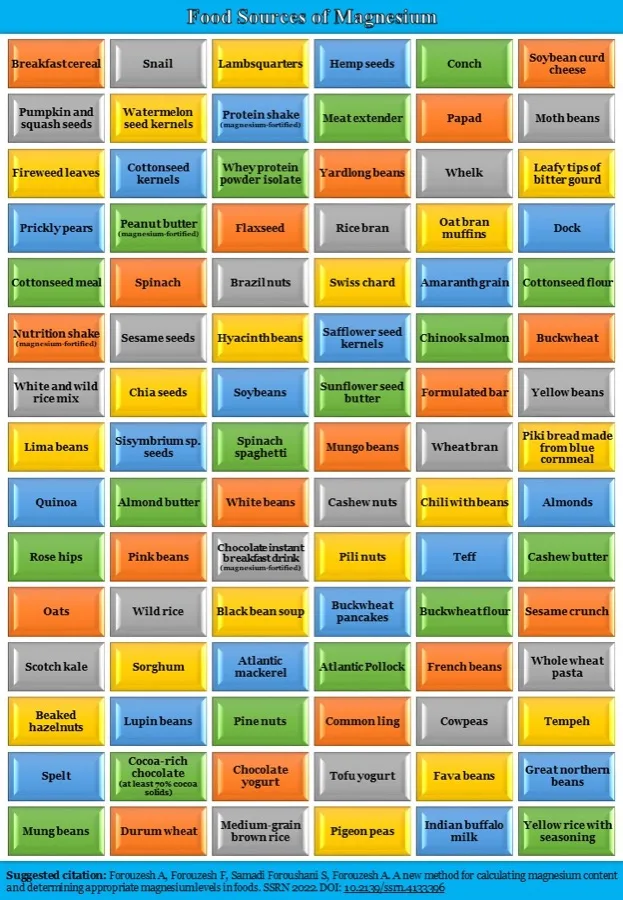 Nuts, seeds, legumes and dark leafy greens are the everyday sources of magnesium. Photo: SSamadi15 (CC BY-SA 4.0, Wikimedia Commons).
Does magnesium really help — and how fast?
This is where most articles overpromise, so here is the actual trial.
Researchers at the University of Reading ran a randomized, double-blind, placebo-controlled crossover study on 38 women, giving 200 mg of magnesium a day across two menstrual cycles. In the first month, it did nothing — no measurable difference against placebo in any symptom category.
In the second cycle, there was a significant reduction in the fluid-retention cluster specifically: weight gain, swelling of the extremities, breast tenderness and abdominal bloating.
Two things follow from that. First, magnesium is worth trying for this particular symptom. Second, judging it after one cycle will tell you nothing — you have to give it two. That single detail is missing from almost every "best supplements for bloating" list, and it is the difference between a fair trial and wasted money.
Walker AF, De Souza MC, Vickers MF, et al. (1998). "Magnesium supplementation alleviates premenstrual symptoms of fluid retention,"
Journal of Women's Health 7(9):1157–65. Conclusion: "A daily supplement of 200 mg of Mg (as MgO) reduced mild premenstrual symptoms of fluid retention in the second cycle of administration."
PubMed 9861593.
Food sources count too: almonds, pumpkin seeds, spinach, black beans and dark chocolate. The Office on Women's Health notes that magnesium may help relieve some PMS symptoms, including migraines.
Reader-favorite formula
Flush Factor Plus — the fluid-balance supplement we reviewed
Flush Factor Plus is a plant-based formula built on six plant-derived ingredients — pineapple (bromelain), shatavari, L-citrulline, black cumin seed, beet root and hibiscus — in a single 500 mg blend. To be clear about what it is not: it contains no magnesium, so it is not a way to run the trial described above. What it does share with that trial is the timescale — its 60-day refund window is roughly the length of a fair test, which is about two cycles. Our full review covers which claims hold up, who should skip it, and the side effects worth knowing.
Price, shipping and guarantee. The official site sells bundles only, no single bottles: $158 USD for 2 bottles ($79 each), $207 for 3 ($69 each) or $294 for 6 ($49 each). Shipping is free inside the United States, 5–7 working days ($15.95 USD to Canada, the UK and Ireland, and Australia and New Zealand, 10–15 working days). Every official order carries a 60-day money-back guarantee that starts the day your package is delivered — it covers opened bottles, but you post them back at your own cost. Prices verified on the official checkout on August 25, 2026.
Read the full Flush Factor Plus review →
Affiliate link. Independent review. Not a substitute for a doctor.
Frequently asked questions
How many days before your period does water retention start?
Usually one to two weeks. The Cleveland Clinic describes PMS as beginning one to two weeks before your period, and puffiness tends to build over that window rather than arrive overnight. For most people the heaviest days are the two or three right before bleeding starts.
How much weight gain is normal before a period?
Two to five pounds of fluid is a common range, and it is water rather than fat. The giveaway is speed: body fat cannot appear in three days. Premenstrual weight climbs in the days before bleeding and drops on its own once your period starts.
How long does premenstrual water retention last?
It clears on its own once your period begins. The Office on Women's Health states that PMS symptoms go away within a few days after a woman's period starts as hormone levels begin rising again. Swelling that stays through the whole month is not PMS and deserves a doctor's opinion.
Does magnesium help water retention before a period?
Modestly, and not immediately. In a randomized, double-blind, placebo-controlled trial of 38 women, 200 mg of magnesium a day made no difference at all in the first month. In the second cycle it produced a significant reduction in fluid-retention symptoms — weight gain, swelling of the extremities, breast tenderness and bloating. If you try it, judge it after two cycles, not one.
Does drinking more water make premenstrual bloating worse?
No — it usually helps. Dehydration prompts the body to hold on to sodium and water. Steady sipping through the day lets your kidneys release the extra fluid instead of clinging to it. Cutting back on fluids to fight puffiness tends to backfire.
Why do my legs and ankles swell before my period?
Gravity decides where premenstrual fluid settles. The extra water is body-wide, but it pools lowest — in the ankles, feet and calves — which is why shoes feel tight by evening and sock lines linger. Standing or sitting all day makes the same amount of fluid look and feel worse.
When should premenstrual swelling be checked by a doctor?
See a doctor if swelling affects only one leg, comes with calf pain, warmth or redness, arrives with shortness of breath or chest pressure, does not clear once your period ends, or is disrupting your daily life. The NHS advises seeing a GP when lifestyle changes have not helped or symptoms are affecting your daily life.
About the author — Dana Reyes
Founder, The Light Legs Guide
For years Dana worked ten-hour shifts on her feet in retail, so she knows exactly how heavy and sore legs feel at the end of a hot day — and how much a long flight makes it worse. Swelling runs in her family too: her mother, grandmother, aunts and cousins all deal with it. She started The Light Legs Guide to share what actually helped her, with every claim linked to a source you can check.
Dana is not a medical professional. Nothing on this site is medical advice.
 Fluid follows gravity, so it settles lowest. Getting the ankles above the heart reverses that for a while. Photo: Shixart1985 (CC BY 2.0, Wikimedia Commons).