Pillar guide
Swollen Ankles: Causes, Home Remedies, and When to Worry

By Dana Reyes
Published Aug 19, 2026 · 11 min read
Quick answer
Ankles swell when fluid leaks from small blood vessels and pools in the lowest part of your body. Most cases come from heat, long hours standing or sitting, salty meals or some medications, and settle in 24–48 hours with elevation, movement and less salt. Sudden, one-sided or painful swelling needs a doctor the same day.
Editorial note: This article links to our own review of a supplement. That review contains an affiliate link — if you buy through it we may earn a small commission at no extra cost to you. It does not change what we recommend. This page is educational and is not a substitute for medical advice — always talk with your doctor about persistent swelling.
What are swollen ankles, exactly?
The medical name is peripheral edema. It happens when the small blood vessels in your legs and ankles leak more plasma than the lymphatic system can drain away. That extra fluid gets trapped in the soft tissue around the joint, and the skin puffs up. Press it with your thumb for five seconds — if it leaves a dent that takes a moment to bounce back, that is called pitting edema.
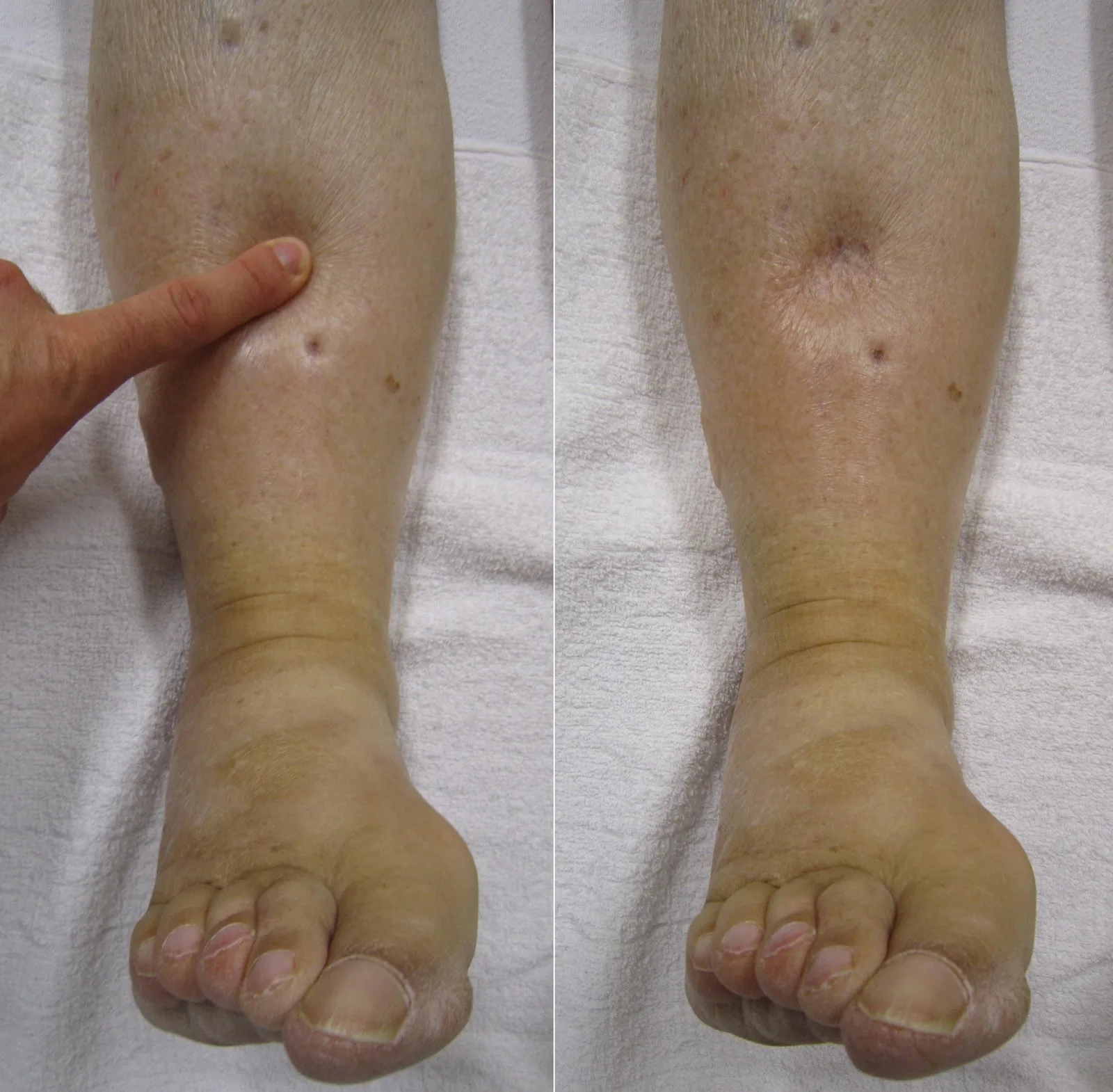 Pitting edema: the skin holds the shape of a finger press for several seconds. Photo: James Heilman, MD (CC BY-SA 3.0, Wikimedia Commons).
Edema is not a disease on its own. It is a symptom, and the same puffy ankle can be caused by anything from a hot afternoon to a serious heart problem. The point of this guide is to help you tell those apart.
The Cleveland Clinic describes edema as "swelling caused by extra fluid trapped in your body's tissues," most commonly in the feet, ankles, and legs.
Cleveland Clinic — Edema.
What causes ankles to swell?
The Mayo Clinic groups causes into two buckets: lifestyle-related and medical-condition-related. Most people worry about the second one first, but the first one is far more common.
Lifestyle causes (the everyday ones)
- Standing or sitting for hours. Gravity pulls plasma down. Airline crew, retail staff, nurses, and long-haul travelers see this constantly. It usually clears with a night of sleep.
- Hot weather. Heat dilates the blood vessels near the skin, which lets more fluid seep into the tissue. If your ankles are worse in July than in January, this is why. We wrote a whole guide on why ankles swell in the heat.
- High-sodium meals. Your kidneys hold extra water to dilute the salt. Restaurant food, canned soup, and cured meats are the usual culprits.
- Not drinking enough water. Counterintuitive, but true. When you are dehydrated your body clings to sodium harder, and swelling gets worse.
- Alcohol. A night out reliably puffs the ankles the next morning.
- Hormonal shifts. The days before a period, pregnancy, and menopause all change fluid balance. We cover the monthly pattern in detail in water retention before your period, and the wider female pattern in water retention in legs.
- Sedentary calf muscles. The calf is your "second heart" — it squeezes veins each time you walk to push blood back up. Sit for eight hours and that pump stops working.
Medication causes
These are more common than people realize. If new swelling started within a few weeks of a new prescription, ask your pharmacist:
- Blood pressure medicines — especially calcium channel blockers like amlodipine, which are famous for swelling ankles.
- NSAIDs — ibuprofen, naproxen, and celecoxib can make the kidneys hold sodium.
- Steroids — prednisone and similar.
- Certain diabetes drugs — pioglitazone in particular.
- Estrogen and hormonal contraceptives.
The Mayo Clinic lists calcium channel blockers, NSAIDs, steroids, thiazolidinediones, and estrogens as common medication triggers for leg edema.
Mayo Clinic — Leg swelling causes.
Vein and lymph causes
- Chronic venous insufficiency. The one-way valves in leg veins fail to close, so blood pools. Very common after age 50. Skin may darken around the ankle.
- Deep vein thrombosis (DVT). A blood clot in a leg vein. Usually one leg only, painful, warm, and red. This is a medical emergency.
- Lymphedema. Damage to the lymph drainage system — from surgery, radiation, or a genetic condition. The swelling is firm, does not pit easily, and often includes the top of the foot.
Organ causes
- Heart failure. The pump can't move blood forward, so it backs up into the legs. Almost always in both ankles, often with shortness of breath and weight gain.
- Kidney disease. Kidneys that can't clear enough salt lead to whole-body swelling — legs, hands, and puffy eyelids in the morning.
- Liver disease (cirrhosis). Low blood protein lets fluid leak into the belly and legs.
Harvard Health explains that congestive heart failure "causes fluid buildup in the lungs and other parts of the body," and that this swelling "is often most visible in the feet and ankles." It also lists kidney disease, liver disease, venous insufficiency and certain medications — including NSAIDs and steroids — among the causes of edema.
Harvard Health — Edema.
When is ankle swelling a warning sign?
Call your doctor today — or 911 — if you have:
- Swelling in only one leg, especially with pain, warmth, or redness in the calf (possible blood clot / DVT).
- Shortness of breath, chest pain, or a cough with pink foam (possible heart failure or pulmonary embolism).
- Swelling that appeared suddenly after a long flight, a surgery, or a period of bed rest.
- Skin that is broken, weeping fluid, or looks infected.
- Swelling with a fever.
- You are pregnant and the swelling is sudden, one-sided, or comes with headache or blurred vision (possible preeclampsia).
None of the home remedies below apply to these situations. Get evaluated first.
How can you reduce swollen ankles at home?
For the everyday, lifestyle-related version, four things move the needle. Combine them for 48–72 hours and most people see visible change.
The four-part reset for mild ankle swelling
- Elevation above heart level, 20 minutes, three times a day
- Walk 5 minutes for every hour of sitting
- Cut sodium to under 2,000 mg for 3 days
- Drink 8–10 cups of water, spread through the day
1. Elevate your ankles above your heart
The single most effective free fix. Lie flat on the floor, stack two pillows against a wall, and rest your calves on them so your ankles are higher than your chest. Fifteen to twenty minutes, three times a day. If you can only do it once, do it at the end of the workday.
2. Move — especially the calves
The calf muscle is what pumps venous blood back up to the heart. If you sit for a living, set a timer: every hour, stand up and do 20 heel-toe raises (rise onto your toes, then rock back on your heels). Ten minutes of walking is even better. On long flights, do the same seated — 30 ankle pumps every hour.
3. Cut added sodium for 72 hours
The American Heart Association recommends staying under 2,300 mg of sodium a day, and ideally under 1,500 mg for most adults. The average American eats over 3,100 mg. Read labels on bread, sauces, deli meat, and soup — those four categories are where most of the sodium hides.
American Heart Association: "Americans consume far too much sodium — on average, over 3,100 milligrams daily," against a recommended ceiling of 2,300 mg and "an optimal goal of no more than 1,500 mg a day for most adults."
AHA — How Much Sodium Should I Eat Per Day?
 Whole foods — fresh vegetables, fruit, unsalted nuts, plain grains — are the easiest way to keep sodium under 1,500 mg. Photo: Shixart1985 (CC BY 2.0, Wikimedia Commons).
4. Drink water on a schedule
Not all at once. Sip through the day: a large glass on waking, one before each meal, and one mid-afternoon. Aim for pale-yellow urine. Chronic mild dehydration triggers the same hormone (aldosterone) that makes the body hold sodium, and swelling gets worse.
5. Compression socks (knee-high, 15–20 mmHg)
The most under-used tool for anyone who stands or sits for a living. A graduated compression sock is tighter at the ankle and looser at the calf, pushing fluid upward. Put them on before you get out of bed, and take them off before sleep.
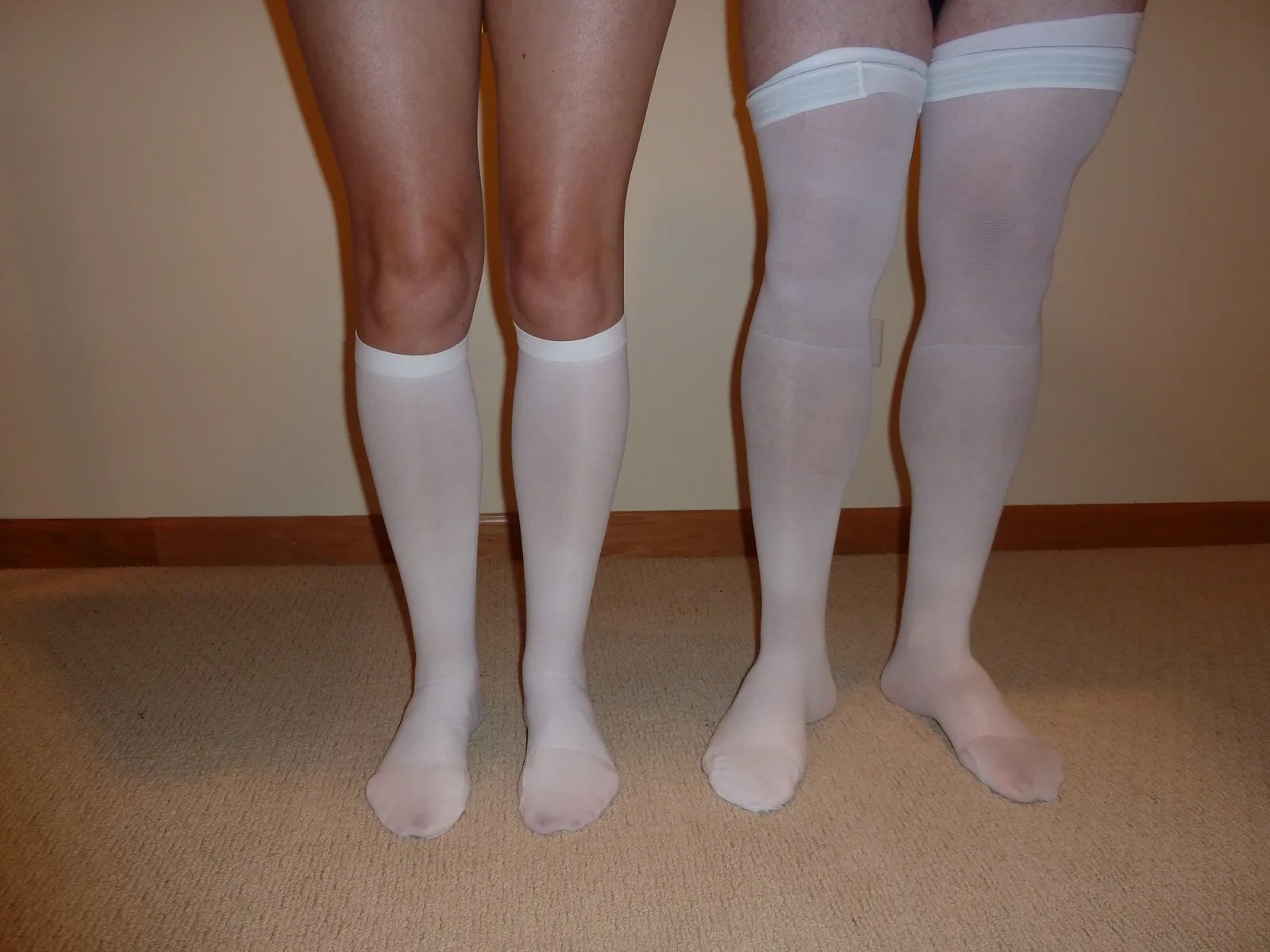 Graduated compression stockings are gentler at the calf than the ankle, using pressure to push venous blood back to the heart. Photo: Lentpjuve (CC BY-SA 4.0, Wikimedia Commons).
6. Cool foot soak or cold compress
Cold constricts blood vessels and gives short-term relief on a hot day. A 10-minute foot bath with cool (not icy) water and a splash of Epsom salts is fine for most people. Skip it if you have diabetic neuropathy or open skin.
7. Move your ankles at your desk
Sitting at a computer? These four moves take 90 seconds and can be repeated every hour:
- Ankle pumps: point toes down, then flex up. 20 reps.
- Ankle circles: 10 clockwise, 10 counter-clockwise, each foot.
- Seated calf raises: lift both heels off the floor 20 times.
- Toe curls: scrunch your toes as if grabbing a pencil, 15 times.
Do supplements for swollen ankles work?
Some do, some don't. The evidence is strongest for a small handful of ingredients:
- Dandelion root — has mild natural diuretic effects in early trials.
- Magnesium — a 2017 review found it modestly reduces mild premenstrual water retention.
- Horse chestnut extract — a Cochrane review concluded it improves symptoms of chronic venous insufficiency, including leg swelling.
- Buchu leaf — traditional diuretic; less rigorous evidence.
- Potassium — helps the kidneys clear excess sodium.
Reader-favorite formula
Flush Factor Plus — the supplement we reviewed in depth
Flush Factor Plus is a plant-based formula built on six plant-derived ingredients — pineapple (bromelain), shatavari, L-citrulline, black cumin seed, beet root and hibiscus — in a single 500 mg blend. It is a circulation-and-fluid formula rather than a diuretic: it contains none of the classic water-pill herbs. We spent weeks on the full review: how it works, who it is (and isn't) for, side effects, refund policy, and where to buy it without middleman markup.
Price, shipping and guarantee. The official site sells bundles only, no single bottles: $158 USD for 2 bottles ($79 each), $207 for 3 ($69 each) or $294 for 6 ($49 each). Shipping is free inside the United States, 5–7 working days ($15.95 USD to Canada, the UK and Ireland, and Australia and New Zealand, 10–15 working days). Every official order carries a 60-day money-back guarantee that starts the day your package is delivered — it covers opened bottles, but you post them back at your own cost. Prices verified on the official checkout on August 25, 2026.
Read the full Flush Factor Plus review →
Affiliate link. Independent review. Not a replacement for medical care.
When should you see a doctor?
Book a visit — not necessarily an ER — if any of these apply:
- Swelling has lasted more than seven days despite home remedies.
- It leaves a deep dent for more than five seconds when pressed.
- You have diabetes, heart disease, kidney disease, or a history of blood clots.
- You started a new medication in the past month.
- The skin around your ankle is discolored (brown or reddish) or has open sores.
- You are gaining weight quickly along with the swelling.
Bring a list of everything you take — prescription, over-the-counter, and supplements. Bring notes on when the swelling is worst (morning vs evening) and how much sodium you eat. That is the fastest path to a good diagnosis.
The NHS recommends seeing a GP if swelling gets worse, has not improved after treating it at home for a few days, gets much worse suddenly, or you have very high temperature or feel unwell.
NHS — Swollen ankles, feet and legs.
Frequently asked questions
Why do my ankles swell at the end of the day?
Standing, sitting, or being on your feet all day lets gravity pull fluid into the lowest part of your body. Blood vessels get leakier when tissues are compressed for hours, so plasma seeps into the surrounding tissue. Elevating your legs above heart level for 15–20 minutes usually reverses it overnight.
Are swollen ankles a sign of heart failure?
They can be. When the heart cannot pump strongly enough, blood backs up in the veins and fluid leaks into the legs. Heart-related swelling is usually in both ankles, often paired with shortness of breath, weight gain, or fatigue. Sudden, severe, or one-sided swelling needs urgent medical review.
Does drinking more water help swollen ankles?
Yes, in most cases. When you are underhydrated your body holds on to sodium and water more tightly, which worsens swelling. Steady water intake through the day, paired with less added salt, usually helps within 48–72 hours for lifestyle-related edema.
How long does it take for swollen ankles to go down?
Mild swelling from heat, standing, or a salty meal usually resolves in 24–48 hours with elevation, walking, and cutting sodium. Swelling that lasts more than a week, is one-sided, or leaves a deep dent when pressed should be evaluated by a doctor.
What is the fastest home remedy for swollen ankles?
Lie down and put your ankles on two pillows so they sit higher than your heart. Combine that with 5–10 minutes of ankle pumps (up-and-down foot flexes) every hour. This uses gravity and the calf muscle pump — the two forces that push fluid back to the heart.
Do compression socks really work for swollen ankles?
Yes, when they are the right strength (usually 15–20 mmHg for everyday swelling), graduated (tighter at the ankle), and worn from morning until bedtime. They do not fix an underlying cause, but they reliably reduce the pooling that gravity creates during the day.
Can swollen ankles be caused by walking too much?
Rarely. Walking normally activates the calf pump and reduces swelling. Sudden ankle swelling after a hike or unusually long walk is more likely mild joint inflammation from impact. If it is one-sided, painful, and warm, get it checked to rule out a stress fracture or DVT.
Related resource
Our in-depth Flush Factor Plus review
Wondering whether a supplement is worth trying before you commit to compression socks and a low-sodium plan? We took Flush Factor Plus apart ingredient by ingredient — what has evidence, what doesn't, who should skip it, and the honest verdict from real use.
Read the Flush Factor Plus review →
Affiliate link — we may earn a commission if you buy through it, at no cost to you.
About the author — Dana Reyes
Founder, The Light Legs Guide
For years Dana worked ten-hour shifts on her feet in retail, so she knows exactly how heavy and sore legs feel at the end of a hot day — and how much a long flight makes it worse. Swelling runs in her family too: her mother, grandmother, aunts and cousins all deal with it. She started The Light Legs Guide to share what actually helped her, with every claim linked to a source you can check.
Dana is not a medical professional. Nothing on this site is medical advice.
 Elevating tired feet is more than a lifestyle image — it is one of the most effective at-home fixes for mild ankle swelling. Photo: Felix Russell-Saw (CC0, Wikimedia Commons).