Causes & symptoms
Water Retention in the Belly: Why Your Stomach Feels Puffy — and When It's More

By Dana Reyes
Published Sep 5, 2026 · 11 min read
Quick answer
Most belly puffiness is everyday water retention or gas — from salt, your cycle, or sitting too long — and it comes and goes within a few days. A belly that keeps swelling, stays tight day after day, or comes with shortness of breath is a different pattern called ascites, a fluid buildup usually linked to the liver, heart or kidneys. Telling the two apart is mostly about timing, not guesswork.
Editorial note: This article links to a supplement we independently reviewed. If you buy through it we may earn a small commission at no cost to you. This page is educational — not medical advice.
Why does your stomach feel puffy?
A puffy stomach is not automatically water retention. Cleveland Clinic diagnoses a distended abdomen with a simple checklist doctors call the five f's: flatus, fetus, feces, fluid, or fat. Gas, pregnancy, trapped stool, fluid and body fat can each push your belly outward on their own.
That matters here because it means most balloon-tight, comes-and-goes bloating is gas or digestion, not fluid at all. Genuine water retention — fluid leaking out of small blood vessels into the surrounding tissue — is one cause among several, and it behaves differently: it tends to build more gradually and ease with time, salt, and movement, rather than shifting within an hour of a meal.
 Not every puffy stomach is water retention — gas, digestion, hormones and fluid can all push the belly outward, and they don't all need the same fix.
Cleveland Clinic: "Healthcare providers diagnose a distended abdomen in terms of the 'five f's': flatus (gas), fetus (pregnancy), feces (trapped poop), fluid (from several causes) or fat."
Cleveland Clinic — Abdominal Distension.
Bloating or water retention — how to tell the difference
The clock is the simplest test you have. Gas from a meal shifts within hours. Everyday water retention builds over a day and usually eases within a few days once the cause — salt, hormones, sitting — passes. Body fat is the slow one: it accumulates over weeks and months, not overnight.
WebMD's own comparison puts it plainly: weight that changes quickly and shows up as puffiness in your stomach, hands or feet is water. Weight that creeps up slowly in your stomach, hips and thighs is fat. A jump the morning after a salty dinner, or the week before your period, points squarely at water.
WebMD: "Water weight changes quickly and can make you feel puffy or bloated, often in your stomach, hands, or feet. Body fat changes slowly and builds up over time in places such as your stomach, hips, and thighs. If your weight changes after eating salty food or around your period, it's likely water weight."
WebMD — Why Am I Retaining Water?.
The everyday causes you can actually change
Most belly water retention traces back to one of these. None of them needs a diagnosis.
1. Sodium
Wherever salt goes, water follows it, and the extra fluid your body holds shows up first in the softest tissue — your abdomen is exactly that. Most of the sodium behind this is not from a salt shaker.
American Heart Association: "Americans consume far too much sodium — on average, over 3,100 milligrams daily," against "an optimal goal of no more than 1,500 mg a day for most adults," and "more than 70% of the sodium Americans eat comes from packaged, prepared and restaurant foods — not the saltshaker."
AHA — How much sodium should I eat per day? (last reviewed July 2025).
2. Your cycle
Cleveland Clinic lists menstruation itself as an organic cause of water retention in the abdomen, driven by the same hormone shifts that cause breast tenderness and mood changes before a period. Magnesium has real trial evidence here, with one caveat worth knowing before you try it and give up.
A double-blind, crossover trial gave 38 women 200 mg of magnesium a day. It did nothing measurable in the first cycle. By the second cycle, fluid-retention symptoms had dropped significantly.
Walker AF, De Souza MC, Vickers MF, et al. (1998). "Magnesium supplementation alleviates premenstrual symptoms of fluid retention,"
Journal of Women's Health 7(9):1157–65. Conclusion: "A daily supplement of 200 mg of Mg (as MgO) reduced mild premenstrual symptoms of fluid retention in the second cycle of administration."
PubMed 9861593.
3. Sitting for long stretches
This one usually gets blamed for ankles, but the same stagnant circulation affects the trunk too. Hours without moving your legs slows the pump that keeps fluid circulating well beyond just your feet.
4. Certain medications
Some everyday and prescription drugs list water retention as a known side effect: NSAIDs like ibuprofen, steroids, some blood pressure medicines, insulin, and certain antidepressants among them. If puffiness started within weeks of a new prescription, that timing is worth mentioning to whoever prescribed it — never stop a medication on your own.
WebMD lists medicines linked to water retention, including "Angiotensin-converting enzyme (ACE) inhibitors," "Nonsteroidal anti-inflammatory drugs (NSAIDs), including ibuprofen," "Steroids," "Insulin," and "Antidepressants."
WebMD — Why Am I Retaining Water?.
Your belly, your ankles, and your face — the same fluid, three places
This blog has covered why ankles swell by evening and why the face puffs up by morning. The belly is the third place the same fluid shows up, and it is worth saying plainly: these are not three separate complaints.
Salt, hormones, and hours of sitting all raise the total amount of fluid your body is holding at any given time. Gravity and position decide where it settles — legs by evening, face by morning, and the abdomen whenever the total load is high enough that it isn't all draining efficiently. If you deal with more than one of these on the same day, that is a sign of overall fluid load, not three unrelated problems.
Our pillar guide to swollen ankles and our article on morning facial puffiness cover the other two ends of this. The full list of water retention causes goes deeper into what raises your total fluid load in the first place.
When belly swelling is something more — ascites
This is the part that matters most to get right, because the same word — bloating — gets used for something ordinary and for something that needs a doctor.
Ascites is a buildup of excess fluid inside the abdominal cavity itself, not in the tissue under the skin. Mayo Clinic is specific about what separates it from everyday bloating: early ascites can feel similar, but it behaves differently over time.
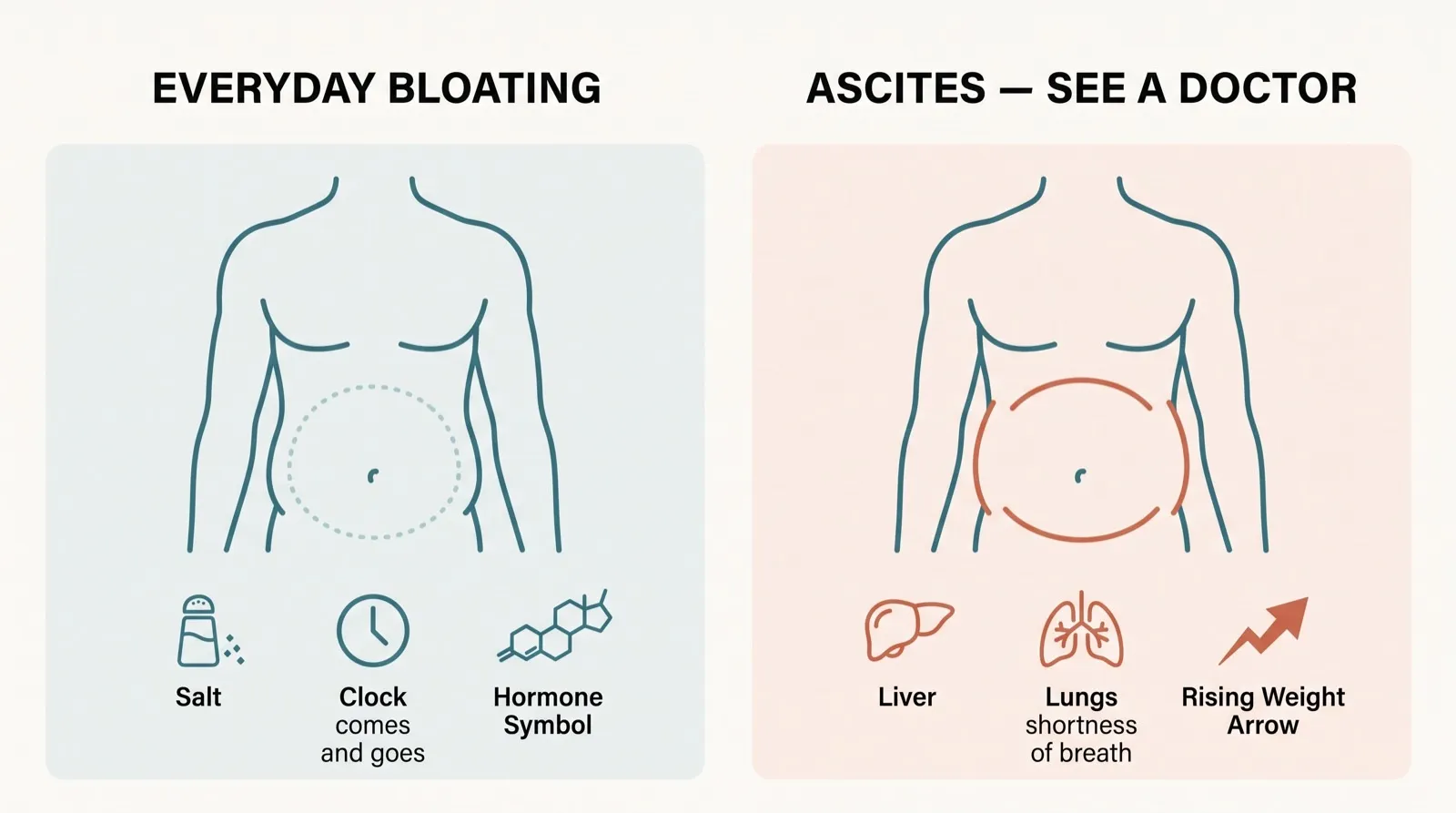 The difference is mostly timing: everyday bloating comes and goes with what you ate or where you are in your cycle. Ascites builds and tends to stay, or get worse, without treatment.
Mayo Clinic: "Ascites occurs when excess fluid builds up in your belly area, called the abdomen... This buildup can make your belly look swollen or feel tight." And: "Early ascites can feel like bloating, but the swelling usually lasts and may get worse over time. While bloating often comes and goes, ascites typically does not get better without treatment."
Mayo Clinic — Ascites.
Mayo Clinic reports that ascites most often happens with advanced liver disease such as cirrhosis, and can also be linked to heart failure, certain cancers and pancreatic disease. As fluid builds, it can bring shortness of breath, feeling full after small meals, belly pain, rapid weight gain, and — notably — swelling in the legs or ankles too, which is exactly why a swollen belly alongside swollen ankles deserves more attention than either alone.
Mayo Clinic lists symptoms of advancing ascites including "Shortness of breath or feeling winded," "Feeling full after small meals," "Belly pain, especially when large amounts of fluid collect," "Swelling in the legs or ankles, called edema," "Rapid weight gain," and "Fever or confusion, which can be signs of infection." Causes include cirrhosis, heart failure, certain cancers and pancreatic disease.
Mayo Clinic — Ascites.
How to ease everyday belly water retention
Everything below works on ordinary fluid and gas. None of it treats ascites, which is exactly why the warning signs below matter more than any home remedy.
 The everyday fix starts at the table: fresh food instead of processed, and steady water instead of none.
What actually helps, in order of effect
- Cut processed and restaurant food, not just the salt shaker. That's where most sodium hides, and it's the biggest single lever.
- Drink water steadily. Cutting back when you feel puffy backfires — a body that senses a shortage holds on to more, not less.
- Move instead of sitting for hours. Walking keeps fluid circulating rather than pooling.
- Give it a few days, not a few hours. Everyday water retention eases over days, not overnight.
- If it's cyclical, give magnesium a full second cycle. The trial evidence shows no effect in month one and a real one in month two.
- Check new medications. If puffiness started with a new prescription, mention the timing to whoever prescribed it.
See a doctor if:
- Your belly keeps growing over days or weeks rather than coming and going.
- Swelling comes with shortness of breath, feeling full after small meals, or unexplained rapid weight gain.
- You have belly pain, especially if it's severe, or a fever.
- Your belly swelling appears alongside swelling in your legs or ankles.
- You notice confusion, or vomit blood — this needs urgent care.
- You have a history of liver, heart, or kidney disease and notice any new abdominal swelling.
These are the pattern Mayo Clinic and Cleveland Clinic both flag as reasons to see a doctor rather than wait it out — not a diagnosis, just the signal that this isn't the kind of swelling a home remedy is meant for.
Reader-favorite formula
Flush Factor Plus — the fluid-balance supplement we reviewed
Flush Factor Plus is a plant-based formula built on six plant-derived ingredients — pineapple (bromelain), shatavari, L-citrulline, black cumin seed, beet root and hibiscus — in a single 500 mg blend. It's aimed at the everyday fluid balance described above, not at ascites or any of the medical causes in this article — no supplement replaces a diagnosis or treats liver, heart or kidney disease. Our full review covers which claims hold up, who should skip it, and the side effects worth knowing.
Price, shipping and guarantee. The official site sells bundles only, no single bottles: $158 USD for 2 bottles ($79 each), $207 for 3 ($69 each) or $294 for 6 ($49 each). Shipping is free inside the United States, 5–7 working days ($15.95 USD to Canada, the UK and Ireland, and Australia and New Zealand, 10–15 working days). Every official order carries a 60-day money-back guarantee that starts the day your package is delivered — it covers opened bottles, but you post them back at your own cost. Prices verified on the official checkout on August 25, 2026.
Read the full Flush Factor Plus review →
Affiliate link. Independent review. Not a substitute for a doctor.
Frequently asked questions
How do I get rid of water retention in my belly?
For everyday belly water retention, cut back on processed and restaurant food, since that is where most sodium hides. Drink water steadily rather than cutting back, move instead of sitting for hours, and give it a few days rather than expecting an overnight fix. If it is tied to your cycle, magnesium has actual trial evidence, though it took a second month to work in that study. None of this applies if your belly keeps getting bigger, stops coming and going, or comes with shortness of breath — that pattern needs a doctor, not a home remedy.
What causes water retention in the belly?
Day to day, the usual causes are a salty meal, the days before your period, sitting for long stretches, and certain medications including NSAIDs, steroids and some blood pressure drugs. Cleveland Clinic lists menstruation as an organic cause of water retention in the abdomen. Less often, persistent belly swelling comes from a medical condition — most seriously ascites, a buildup of fluid in the abdominal cavity that Mayo Clinic links most often to advanced liver disease, and also to heart failure, kidney disease and certain cancers.
How to tell if it's belly fat or water retention?
WebMD's own comparison is the clearest test: water weight changes quickly and can make you feel puffy or bloated, often in your stomach, hands, or feet, while body fat changes slowly and builds up over time in places such as your stomach, hips, and thighs. If your weight changes after eating salty food or around your period, it's likely water weight. If it increases slowly over time, it's more likely body fat.
Why is my stomach bloated and feels like a balloon?
Cleveland Clinic diagnoses a swollen abdomen using what it calls the five f's: flatus (gas), fetus (pregnancy), feces (trapped stool), fluid, or fat. A tight, balloon-like feeling that comes on after a meal is usually gas or digestive content, not water. Tightness that builds gradually over days and doesn't fully go away, especially with a heavy or full feeling, points more toward fluid — and that's worth mentioning to a doctor if it doesn't settle.
How do I get fluid out of my belly?
If the fluid is everyday water retention — salt, hormones, sitting — the steps above generally clear it within days. If your belly is genuinely filling with fluid inside the abdominal cavity, that's ascites, and it is not something to try to fix at home. Mayo Clinic notes it typically requires treating the underlying cause, sometimes alongside medication or, for large amounts, having the fluid drained by a doctor. Reaching for a diuretic tea or a detox product for a swollen belly that keeps growing delays care it may actually need.
How to debloat your tummy quickly?
Skip the salt for the rest of the day, walk instead of sitting, and drink water steadily instead of a large glass at once — your body holds on to more fluid when it senses a shortage. These steps work on ordinary bloating and water retention within hours to a couple of days. They won't move fluid that's built up from a medical cause, which is the difference worth knowing before you try to rush it.
Is bloating before my period the same as water retention?
Largely yes. Cleveland Clinic lists menstruation itself as a cause of water retention, driven by hormone shifts across the cycle. A 1998 randomized trial found that 200 mg of magnesium a day reduced premenstrual fluid-retention symptoms — but only from the second cycle of taking it, not the first. That timing matters: a supplement that seems to do nothing after two weeks may still be worth a second month before judging it.
About the author — Dana Reyes
Founder, The Light Legs Guide
For years Dana worked ten-hour shifts on her feet in retail, so she knows exactly how heavy and sore legs feel at the end of a hot day — and how much a long flight makes it worse. Swelling runs in her family too: her mother, grandmother, aunts and cousins all deal with it. She started The Light Legs Guide to share what actually helped her, with every claim linked to a source you can check.
Dana is not a medical professional. Nothing on this site is medical advice.