Causes & symptoms
Swollen Calves: Causes, One Leg vs. Both & When to Worry

By Dana Reyes
Published Oct 29, 2026 · 8 min read

Quick answer
When both calves swell, it's usually fluid pooling from gravity, long hours on your feet or sitting, salt or medicines. It tends to ease overnight or when you raise your legs. One swollen calf is different. If it's also painful, warm or discolored, it can be a muscle injury or a blood clot (DVT), and it needs a doctor quickly.
Editorial note: This article links to a supplement we independently reviewed. If you buy through it we may earn a small commission at no cost to you. This page is educational — not medical advice.
Most articles about leg swelling treat the whole leg as one thing. The calf deserves its own page. It's where your body's main muscle pump sits, and it's where the deep leg veins run. Those are also the veins where clots tend to form. So a puffy calf can mean very ordinary fluid, a strained muscle, or, less often, something that needs care the same day.
This guide gives you one simple way to sort them: both legs or one, painless or painful, and does it come and go? Everything below is taken from Mayo Clinic, the NHS, MedlinePlus and Cleveland Clinic, linked so you can check it yourself.
Why do calves swell in the first place?
Mayo Clinic splits leg swelling into two families. The first is fluid buildup (doctors call it peripheral edema), where fluid leaks out of the blood vessels and collects in the tissue. The second is inflammation, where an injured or irritated muscle, joint or tissue swells as part of its response.
Mayo Clinic: "Leg swelling can affect any part of the legs. This includes the feet, ankles, calves and thighs. Leg swelling may be the result of fluid that builds up… Leg swelling also may be the result of inflammation in damaged tissues or joints."
Mayo Clinic — Leg swelling.
Fluid obeys gravity, so it usually shows up first around the ankles and then climbs. MedlinePlus says painless swelling can include the calves or even the thighs, and that gravity makes it most noticeable in the lower body. If your ankles already puff up by evening, swollen calves are often the same problem a little further up. Our pillar guide to swollen ankles covers that side in detail.
Both calves or just one? The question that matters most
This is the quickest way to sort calf swelling, and every major source uses it. Fluid buildup from everyday causes usually affects both legs fairly evenly. A clot, an injury or a burst cyst usually affects one.
MedlinePlus: "Painless swelling may affect both legs and may include the calves or even the thighs. The effect of gravity makes the swelling most noticeable in the lower part of your body."
MedlinePlus — Foot, leg, and ankle swelling.
NHS, on DVT symptoms: "throbbing pain in 1 leg (rarely both legs), usually in the calf or thigh" and "swelling in 1 leg (rarely both legs)".
NHS — DVT (deep vein thrombosis).
Three questions to sort your swelling
- One leg or both? Both legs points toward fluid. One leg needs a closer look.
- Painless or painful? Everyday fluid swelling is usually puffy and heavy but not painful. Throbbing pain, tenderness, warmth or red, blue or darkened skin points away from simple fluid.
- Does it come and go? Fluid swelling builds during the day and eases overnight or when you raise your legs. Swelling that stays, gets worse, or appeared suddenly for no clear reason needs a doctor.
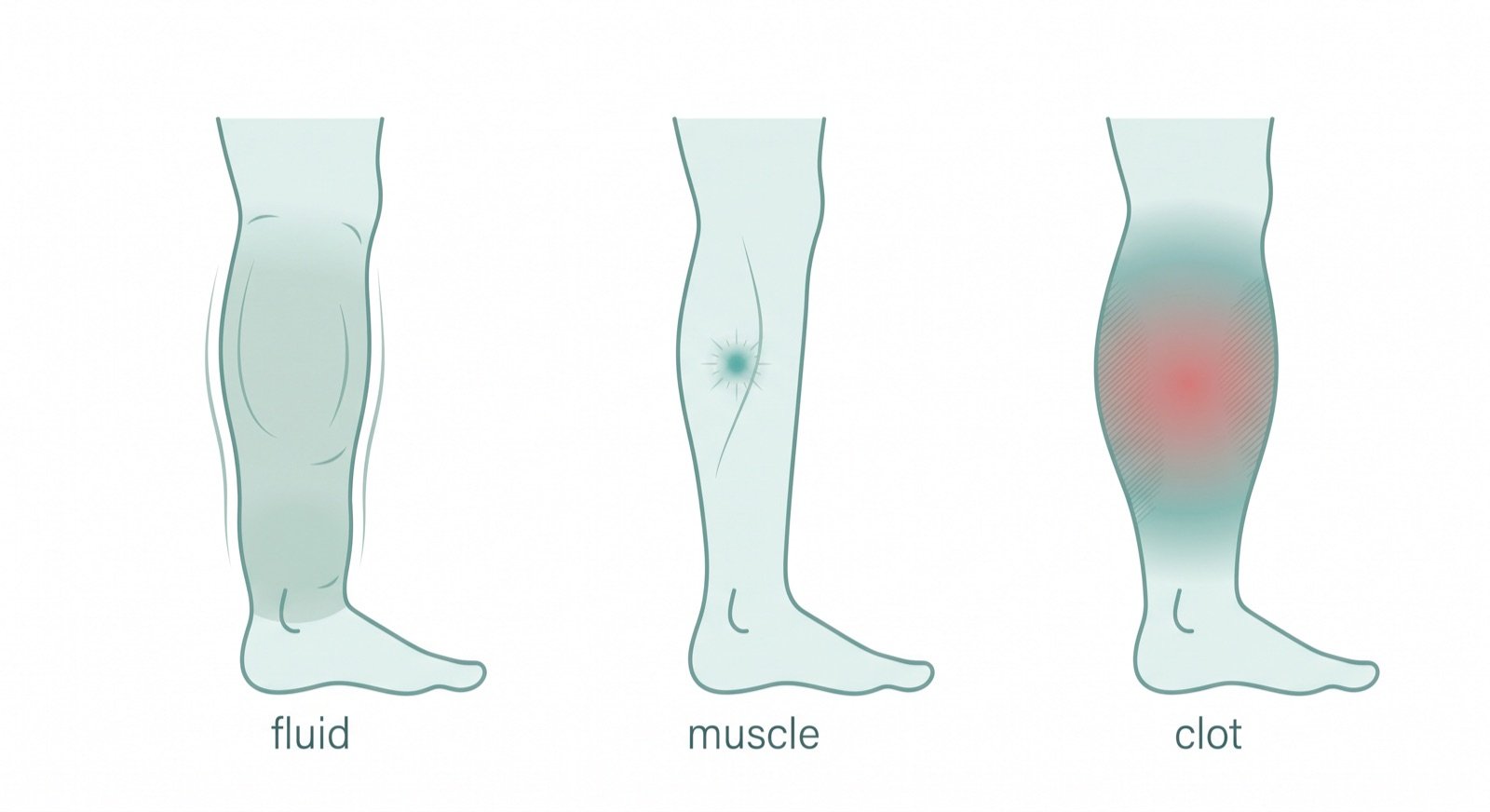 Fluid, muscle or clot: three common reasons for a swollen calf, and how each one tends to look.
Cause 1: Fluid buildup (the common, both-legs kind)
This is by far the most common reason, and the one most readers of this site deal with. Mayo Clinic is clear that leg swelling isn't always a sign of a heart or circulation problem.
Mayo Clinic: "You can have swelling due to fluid buildup from being overweight, being inactive, sitting or standing for a long time, or wearing tight stockings or jeans."
Mayo Clinic — Leg swelling.
Other everyday triggers on the same lists: long flights or car rides, estrogen and parts of the menstrual cycle, and several common medicines. MedlinePlus names calcium channel blockers (a blood pressure medicine), NSAID pain relievers, steroids, some antidepressants, and hormones such as estrogen and testosterone. Never stop a prescription on your own because of swelling; talk to whoever prescribed it.
Veins matter here too. In chronic venous insufficiency, the leg veins struggle to return blood to the heart. MedlinePlus says this is most often due to varicose veins. The calf muscle normally squeezes those veins every time you walk, which is why long stretches of standing still or sitting make calf swelling worse.
The serious fluid causes also usually show in both legs: heart failure, kidney disease and liver disease. MedlinePlus explains that in these conditions there is too much fluid in the body and it collects in the legs. If you have any of them and your swelling gets worse, contact your doctor right away. Our guide to water retention in the legs walks through those warning signs.
Cause 2: A muscle problem (usually one leg, with pain)
The calf is a working muscle, and muscles get hurt. Cleveland Clinic lists cramps, strains, contusions (a direct knock) and tendonitis among the common causes of calf pain. A strain is the one most likely to swell.
The clue is usually a moment you remember: a quick pivot, a jump, a sudden stop, a misstep off a curb. Cleveland Clinic notes that people over 40 may be more likely to get strains during physical activity, so this isn't only an athlete's problem.
Here's the part almost nobody mentions. A "pulled calf" and a blood clot can feel alike, and doctors know it.
So if your calf suddenly hurts and swells and you can't point to a clear moment of injury, don't assume it's a strain and wait it out. Get it looked at.
The Baker cyst: swelling that starts behind the knee
A Baker cyst is a fluid-filled bulge at the back of the knee, usually linked to arthritis or a cartilage tear. On its own it causes tightness behind the knee. Sometimes it affects the calf.
Mayo Clinic: "Rarely, a Baker cyst bursts and synovial fluid leaks into the calf region." This may cause sharp knee pain, "Swelling in the calf" and "A change in skin color of the calf or a feeling of water running down the calf."
Mayo Clinic — Baker cyst.
Mayo Clinic adds that pain and swelling behind the knee should be seen right away, because, though it's rare, they may be a sign of a blood clot. Same lesson as the strain: the symptoms overlap, so a doctor has to tell them apart.
Cause 3: A blood clot (DVT), the one not to miss
Deep vein thrombosis is a clot in a deep vein, most often in the leg. It's not the most common reason for swollen calves, but it's the most important to rule out, because part of the clot can travel to the lungs.
The NHS lists the typical signs in the leg: throbbing pain in one leg, usually in the calf or thigh; swelling in one leg; red, blue or darkened skin around the painful area (harder to see on brown or black skin); and swollen veins.
It also lists who is more likely to get one. Being over 60, carrying extra weight, smoking, a previous DVT, taking HRT or estrogen-containing contraception, cancer, heart failure and varicose veins are all on the list. So are some situations: recent surgery or a hospital stay, being confined to bed for 3 days or more, a journey longer than 4 hours by plane, car or train, pregnancy or the 6 weeks after giving birth, and dehydration. If one calf swells after a long trip, our guide to swollen legs after a flight covers the travel side.
Call 911 (or your local emergency number) if:
- You have leg swelling and chest pain, trouble breathing, or shortness of breath. Mayo Clinic and the NHS both warn this can mean a clot has reached the lungs.
- You have leg swelling and feel faint or dizzy, or you cough up blood.
Get medical care the same day if:
- One calf is swollen, especially with pain, warmth, or red, blue or darkened skin.
- The swelling came on suddenly, for no clear reason.
- It followed an injury, such as a fall, sports injury or car accident.
- You have pain and swelling behind the knee.
- You have heart, kidney or liver disease and the swelling is getting worse.
Mayo Clinic adds that one-sided swelling can sometimes come with skin that feels cool and looks pale. That needs urgent care too.
What helps everyday swollen calves?
If your swelling fits the common pattern (both legs, painless, worse by evening, better in the morning), the advice from Mayo Clinic and MedlinePlus is simple and costs almost nothing.
For everyday fluid swelling
- Raise your legs above your heart. MedlinePlus: put your legs on pillows to raise them above your heart while lying down.
- Use the calf pump. Walking and simple heel raises squeeze the veins. MedlinePlus says exercising your legs "helps pump fluid from your legs back to your heart."
- Take breaks. If you have to stand or sit for long periods, Mayo Clinic says to give yourself frequent breaks and move around.
- Go easier on salt. Both sources say a lower-salt diet may reduce fluid buildup.
- Try support or compression stockings, but not ones that dig in. Mayo Clinic: if you can see the imprint of the elastic on your skin, they may be too tight. Our compression socks guide explains pressure levels and who shouldn't use them.
- Skip tight clothing around your thighs. MedlinePlus lists it among the things to avoid, and Mayo Clinic names tight stockings or jeans as a cause of fluid buildup.
 Raising your legs above heart level lets gravity work for you instead of against you.
For a strained muscle, the approach changes. Cleveland Clinic recommends RICE: rest, ice for 20 minutes every two hours (never directly on the skin), a compression wrap, and elevation. While it heals, it advises against heat, massage and alcohol. And as covered above, a calf that swells suddenly without a clear injury should be checked for a clot before you treat it as a strain.
Reader-favorite formula
Flush Factor Plus — the fluid-balance supplement we reviewed
If your calves swell the everyday way (both legs, painless, worse by evening), Flush Factor Plus is the supplement we spent weeks looking into. It's a plant-based formula built on six ingredients (pineapple bromelain, shatavari, L-citrulline, black cumin seed, beet root and hibiscus) in a single 500 mg blend. It's meant for everyday puffiness, not for blood clots, muscle injuries, or heart, kidney or liver disease. Our full review covers the dose behind each ingredient, the research it's based on, and who should skip it.
Price, shipping and guarantee. The official site sells bundles only, no single bottles: $158 USD for 2 bottles ($79 each), $207 for 3 ($69 each) or $294 for 6 ($49 each). Shipping is free inside the United States, 5–7 working days ($15.95 USD to Canada, the UK and Ireland, and Australia and New Zealand, 10–15 working days). Every official order carries a 60-day money-back guarantee that starts the day your package is delivered — it covers opened bottles, but you post them back at your own cost. Prices verified on the official checkout on August 25, 2026.
Read the full Flush Factor Plus review →
Affiliate link. Independent review. Not a substitute for a doctor.
Where this fits with the rest of your legs
If your calves swell on both sides, your ankles and feet almost always do too, and often your face is puffier in the morning. That's the same fluid moving around your body through the day, as we explain in our puffy face article. Treat it as one pattern, not three separate problems.
The one exception is the one this whole page is built around: a single swollen, painful calf is not part of that pattern. No supplement, sock or home remedy belongs in that situation until a doctor has ruled out a clot.
Frequently asked questions
What causes swollen calves?
Mayo Clinic groups leg swelling into two families: fluid buildup and inflammation. Fluid buildup comes from things like standing or sitting for a long time, being inactive, extra weight, some medicines, vein problems, or heart, kidney and liver disease. Inflammation comes from injuries such as a pulled calf muscle, a ruptured Baker cyst or an infection. A blood clot (DVT) can also cause it.
Should I worry if only one calf is swollen?
Yes, get it checked promptly. Mayo Clinic says to get care right away if leg swelling happens in one leg, and MedlinePlus says to contact your provider for new or worsened swelling in only one leg. The NHS lists swelling and throbbing pain in one leg, usually in the calf or thigh, as typical DVT symptoms.
Can a pulled calf muscle be a blood clot?
Sometimes. Cleveland Clinic notes that up to 10% of people with symptoms of calf pulls have DVT, which is why doctors may order an ultrasound to rule out a clot before treating it as a strain.
Why are both of my calves swollen at the end of the day?
Usually gravity. MedlinePlus says painless swelling may affect both legs, including the calves, and that standing for long periods often leads to some swelling. If it eases overnight or when you raise your legs, that points to ordinary fluid buildup. If it doesn't, or keeps getting worse, see a doctor.
How do I reduce swelling in my calves?
For everyday fluid swelling, MedlinePlus and Mayo Clinic suggest raising your legs on pillows above heart level, moving your legs regularly, cutting back on salt, wearing support stockings, and taking breaks if you stand or sit for long periods. For a strain, Cleveland Clinic recommends rest, ice, compression and elevation.
Can a Baker cyst cause calf swelling?
Yes. Mayo Clinic explains that a Baker cyst is a fluid-filled bulge behind the knee. Rarely it bursts and the fluid leaks into the calf, causing sharp knee pain, calf swelling and a feeling of water running down the calf. Because the symptoms overlap with a blood clot, Mayo advises seeking care right away for pain and swelling behind the knee.
Does Flush Factor Plus help with swollen calves?
It is designed for everyday, gradual fluid puffiness that affects both legs. It does not treat or prevent blood clots, muscle injuries, Baker cysts, or swelling from heart, kidney or liver disease, and one swollen, painful calf needs a doctor first.
About the author — Dana Reyes
Founder, The Light Legs Guide
For years Dana worked ten-hour shifts on her feet in retail, so she knows exactly how heavy and tight calves feel at the end of a long day. Swelling runs in her family too: her mother, grandmother, aunts and cousins all deal with it. She started The Light Legs Guide to share what actually helped her, with every claim linked to a source you can check.
Dana is not a medical professional. Nothing on this site is medical advice.